
U.S.–China Trade Law Changes Are Forcing a Legal Rebuild of the Supply Chain
For many companies, the first wave of U.S.–China trade disruption was treated as a pricing problem.
Tariffs rose, landed costs shifted, and procurement teams responded the way they often do under margin pressure: by looking for alternate factories, secondary assembly jurisdictions, or faster routing options that could preserve customer pricing and reduce concentration risk. Operationally, many of those moves made sense. In practice, however, the legal architecture underneath those shifts often remained frozen in an earlier version of the supply chain.
That is where the real exposure is building.
The current phase of U.S.–China trade law change is no longer simply about tariffs. It is about the legal restructuring of supplier relationships, manufacturing rights, distribution continuity, export controls, and intellectual property ownership across an increasingly fragmented global production network. Companies are actively accelerating “China+1” strategies into Southeast Asia, India, Mexico, and other secondary hubs, yet many still retain upstream tooling, process control, component sourcing, firmware logic, or technical know-how that remains deeply tied to legacy China-based partners.
This means the operational pivot may be moving faster than the legal reality.
That gap is where risk compounds.
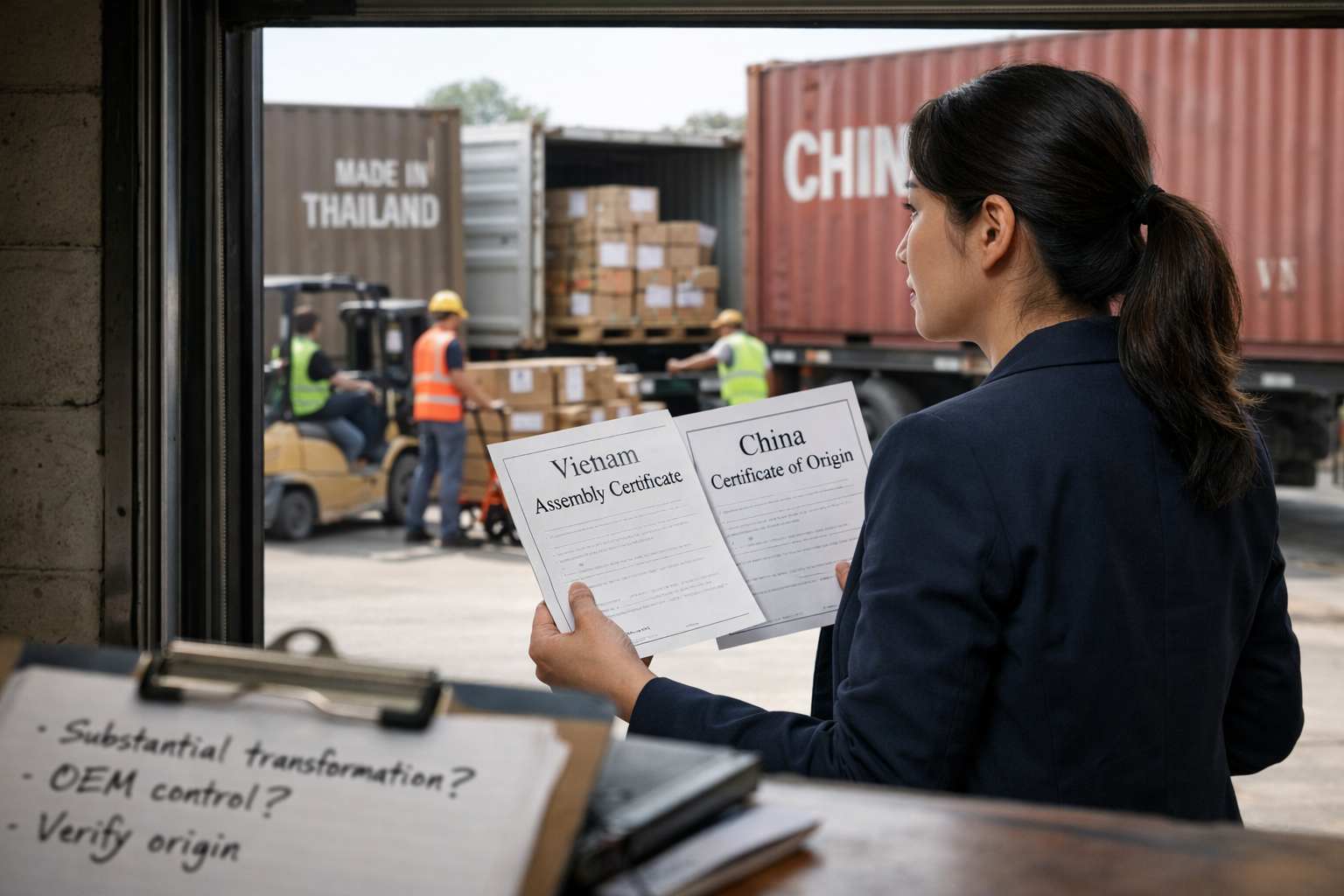
One of the most underestimated pressure points in this transition is country-of-origin integrity. Many businesses assume that moving final assembly or partial processing to Malaysia, Vietnam, Thailand, India, or Mexico automatically solves the tariff issue. The commercial logic feels intuitive: if production moved, the tariff exposure should move with it. Yet substantial transformation rules are far more exacting than operational intuition. If the transformation in the new jurisdiction is not legally sufficient, the product may still retain Chinese origin for customs purposes, exposing the importer to duties, penalties, retroactive assessments, or even seizure risk.
What makes this especially dangerous is that the business may believe it has already diversified.
The paperwork may tell a different story.
This is why transshipment risk has become one of the defining legal issues of the current supply-chain environment. A company may route product through a secondary jurisdiction, complete limited assembly steps, and rely on new invoices and shipping documents that suggest a diversified sourcing model. But if the manufacturing evidence does not support a true change in origin, what looked like resilience planning can quickly become a customs enforcement issue. At that point, the problem is no longer logistics. It is the legal defensibility of the sourcing narrative.
This same dynamic is reshaping supplier contracts.
As businesses move portions of manufacturing outside China, the original Chinese contract manufacturer often remains embedded in the most valuable layers of the supply chain: tooling, molds, firmware, process optimization, approved vendor lists, packaging specifications, bill-of-material logic, and tacit production know-how that never made its way into formal documentation. The move to a secondary hub can therefore expose a hidden truth—many companies do not actually own the operational DNA of their own products as cleanly as they assumed.
That is where OEM and ODM disputes begin.
The most expensive conflicts in this environment are increasingly not tariff disputes, but ownership disputes triggered by diversification. If the original contract manufacturing agreements did not clearly allocate rights over tooling, design improvements, derivative firmware, process changes, or supplier-developed efficiencies, the attempt to move production can create immediate leverage for the incumbent manufacturer. What looked like a sourcing transition becomes an IP control fight, often at the exact moment the business is most operationally vulnerable.
This is especially acute in electronics, AI-enabled tooling, medtech, industrial systems, and advanced manufacturing, where value sits not only in the physical product but in the firmware, calibration logic, process tolerances, and embedded technical workflows that govern how the product performs.
At the same time, export controls and dual-use restrictions are expanding the legal complexity of ordinary supplier relationships.
A manufacturing support clause that once felt routine may now intersect with cross-border technical data transfer rules, semiconductor restrictions, encryption controls, AI tooling limitations, or advanced-computing export requirements. Even companies far outside the semiconductor sector are discovering that industrial sensors, robotics, software-assisted manufacturing environments, aerospace components, and data-rich production systems can all trigger a much more complex compliance analysis than the original supply agreement anticipated.
This means legal review now needs to move upstream into engineering access, technical support rights, remote troubleshooting, firmware updates, and the sharing of production-side process intelligence.
The restructuring pressure does not stop at manufacturing.
Distributor exits, novations, and regional handoffs are becoming equally important. As businesses unwind China-linked distributors or reassign regional rights into ASEAN, LATAM, India, or Middle East channels, the legal question is not merely who takes over the customer relationship. It is whether warranties, indemnities, exclusivity rights, tooling obligations, sell-off inventory rights, and post-termination confidentiality survive the move in a way that protects continuity.
Too often, diversification imports the old dispute into the new geography.
That is why the most sophisticated companies are now treating supply-chain diversification as a legal restructuring event rather than a sourcing decision.
The operational move to a second factory is only the visible layer. The real strategic work is rebuilding the legal framework that governs origin substantiation, transshipment controls, export restrictions, sanctions screening, contract manufacturing ownership, tooling rights, vendor novations, and distributor continuity so that the new network is not simply diversified in appearance but defensible in reality.
This is exactly where leadership teams gain leverage.
The organizations that will come out strongest in this phase are not just those that diversify first, but those that rebuild supplier agreements, OEM/ODM ownership terms, export-control workflows, origin evidence, and novation architecture before geopolitical pressure or enforcement turns an operational pivot into a margin, customs, or ownership crisis.
For manufacturers, AI hardware companies, medtech platforms, industrial suppliers, and any business actively executing a China+1 strategy, now is the time to test whether your legal infrastructure has actually caught up to your operational diversification. A focused consultation can quickly uncover where origin logic, transshipment controls, OEM/ODM ownership, distributor exits, and export-control triggers are already drifting apart beneath the surface. And for leadership teams determined to turn diversification into protected enterprise value rather than inherited legal risk, this is the right moment to schedule a strategic supply-chain legal architecture consultation before the next sourcing shift becomes an avoidable customs, IP, or continuity dispute.