
Tariff Refund Rights Are Reshaping How Global Contracts Protect Margin
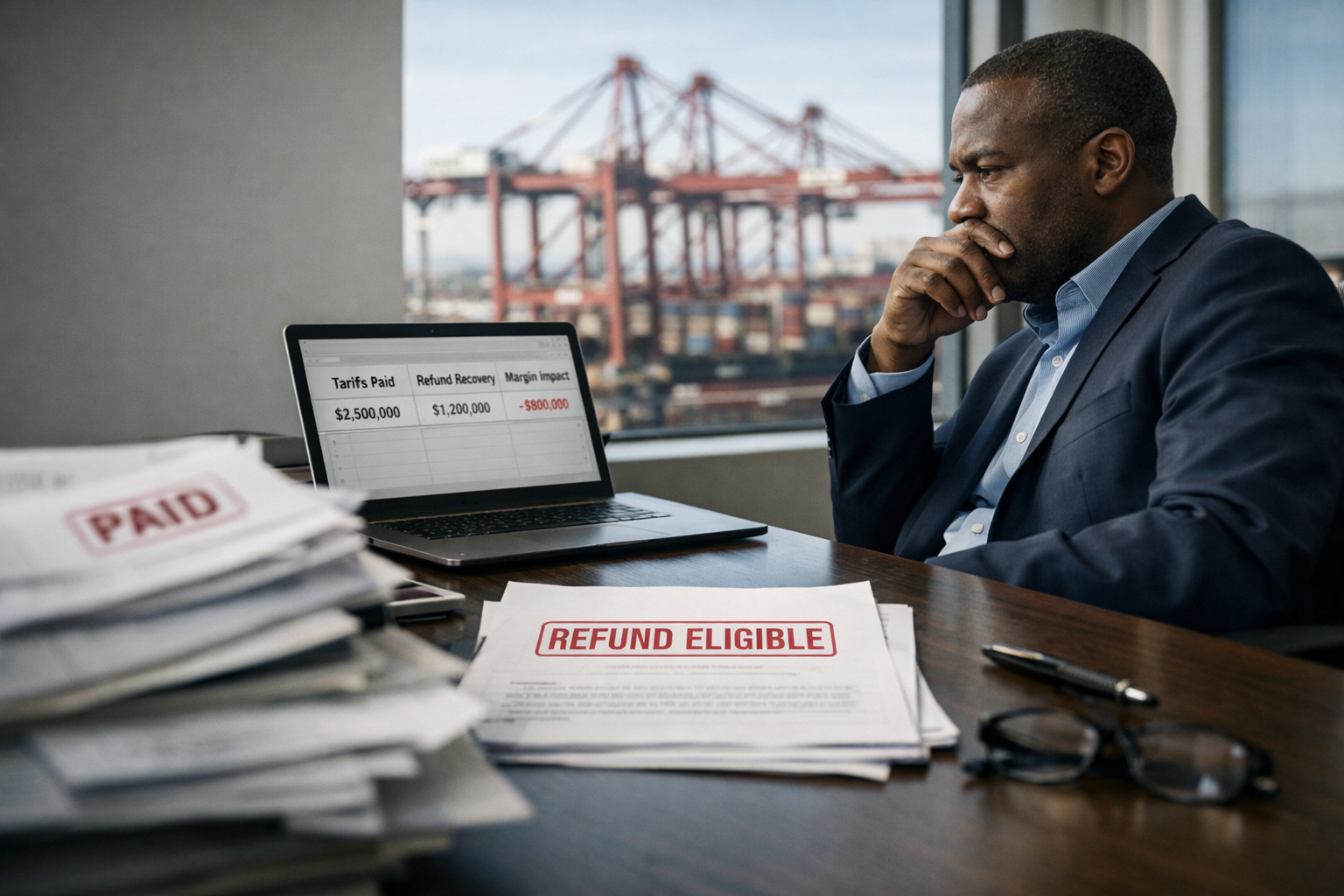
For many importers, the most important tariff issue in 2026 is no longer the next duty increase.
It is what happens when duties already paid may no longer have been lawful in the first place.
The Supreme Court’s February 2026 decision invalidating broad IEEPA-based reciprocal tariffs changed the commercial assumptions behind thousands of international supply and distribution agreements. What initially looked like a geopolitical trade development has quickly become a far more consequential business issue: the possibility that significant duties previously treated as sunk cost may now become recoverable assets. That possibility is already forcing importers, manufacturers, distributors, and global sourcing teams to revisit how their contracts allocate tariff burden, recovery rights, and post-refund economics.
This is where the issue moves far beyond customs.
For executive teams, the real question is no longer simply whether a refund can be obtained through protest rights, Court of International Trade claims, negotiated supplier offsets, or other recovery pathways. The larger question is whether the business can actually preserve the economic value of that recovery once it arrives. A refund right that is not matched by clear contractual allocation can quickly dissolve into internal disputes, supplier claims, customer surcharge challenges, or downstream channel conflicts.
That is why tariff volatility is now as much a contract-value issue as a trade issue.
Most international sales agreements in circulation today were drafted for a world in which tariffs were treated as external background variables. The contracts often assumed that if duties changed, the financial impact would be handled through ordinary commercial negotiation. That assumption no longer works in an environment where tariffs may be imposed, suspended, invalidated, replaced under a new authority, or partially refunded years later.
The margin consequences are simply too significant.
For companies importing into the United States, tariff legality now directly influences landed-cost assumptions, inventory financing decisions, resale pricing, customer surcharge logic, and even internal transfer-pricing models. A duty that once drove pricing decisions across an entire product line may now become subject to reversal, which means the commercial agreements built on top of that duty assumption may also need to unwind.
That is where contract architecture becomes critical.
One of the most underestimated issues in this environment is the false confidence many teams place in Incoterms. Delivery structures like DDP, FOB, or CIF may define who handles transportation obligations and customs formalities, but they rarely answer the more valuable question of who owns the economic benefit of a successful duty recovery. The importer of record may receive the administrative refund, yet the tariff burden may already have been passed downstream through distributor pricing, customer surcharges, or supply-chain finance structures.
When the contract is silent, recovery becomes conflict.
This is why refund ownership is rapidly becoming one of the most important concepts in global supply agreements.
A company may win a customs challenge and recover a substantial amount from CBP, only to discover that suppliers, customers, distributors, or financing counterparties each believe they are entitled to part of the recovery. The commercial dispute often emerges precisely because the original agreement treated tariffs as a temporary pricing problem instead of a recoverable legal asset. Without clear ownership language, the company risks converting a successful trade recovery into a preventable contract fight.
The same pressure is now appearing in retroactive pricing mechanisms.
Over the last several years, many companies built tariffs directly into surcharge invoices, transfer-pricing formulas, resale commitments, and supplier burden-sharing arrangements. Those commercial decisions made sense when the duties were assumed to be durable. Once refunds enter the picture, however, the absence of a clear true-up framework creates immediate uncertainty around how prior invoices, downstream pricing, and supplier concessions should be reconciled.
That is where recovered value can quietly disappear.
The most sophisticated companies are no longer asking only whether they can file a protest or participate in refund litigation. They are asking whether the commercial contract is sophisticated enough to preserve the financial benefit of that recovery across the full value chain. That means revisiting tariff escalation logic, duty reallocation provisions, supplier offset language, change-in-law clauses, and refund cooperation obligations so that the business is not forced into post-recovery renegotiation.
This is especially important because tariff uncertainty has become structurally different.
The risk is no longer one-directional. It is not just about higher duties. It is about future increases, partial suspensions, retroactive invalidation, substitute tariff authorities, and delayed refund rights that may surface long after pricing decisions were made. In practical terms, companies now need contracts that can absorb volatility in both directions—upside and downside—without eroding margin certainty.
That is what separates reactive trade management from strategic contract governance.
The organizations that will preserve the most value in this environment are the ones aligning customs recovery strategy with commercial agreements before refund rights mature into active claims. They are building contract systems that treat tariffs as dynamic financial variables rather than static cost assumptions. They understand that the true leverage is not only winning the refund, but keeping the refund.
For importers, manufacturers, distributors, and finance leaders, now is the time to pressure-test whether your international sales agreements, surcharge structures, and supplier terms actually preserve the economic value of tariff recovery. A focused consultation can quickly uncover where refund ownership, duty reallocation, Incoterms assumptions, and retroactive pricing rights are already misaligned in ways that threaten margin preservation. And for organizations facing active tariff recovery opportunities or future duty volatility, this is the ideal moment to schedule a strategic trade-contract consultation so that recoverable duties become protected enterprise value rather than the start of a commercial dispute.