
U.S.-China Trade War Tariffs in 2026: What the Latest Numbers Mean for Midwest Businesses
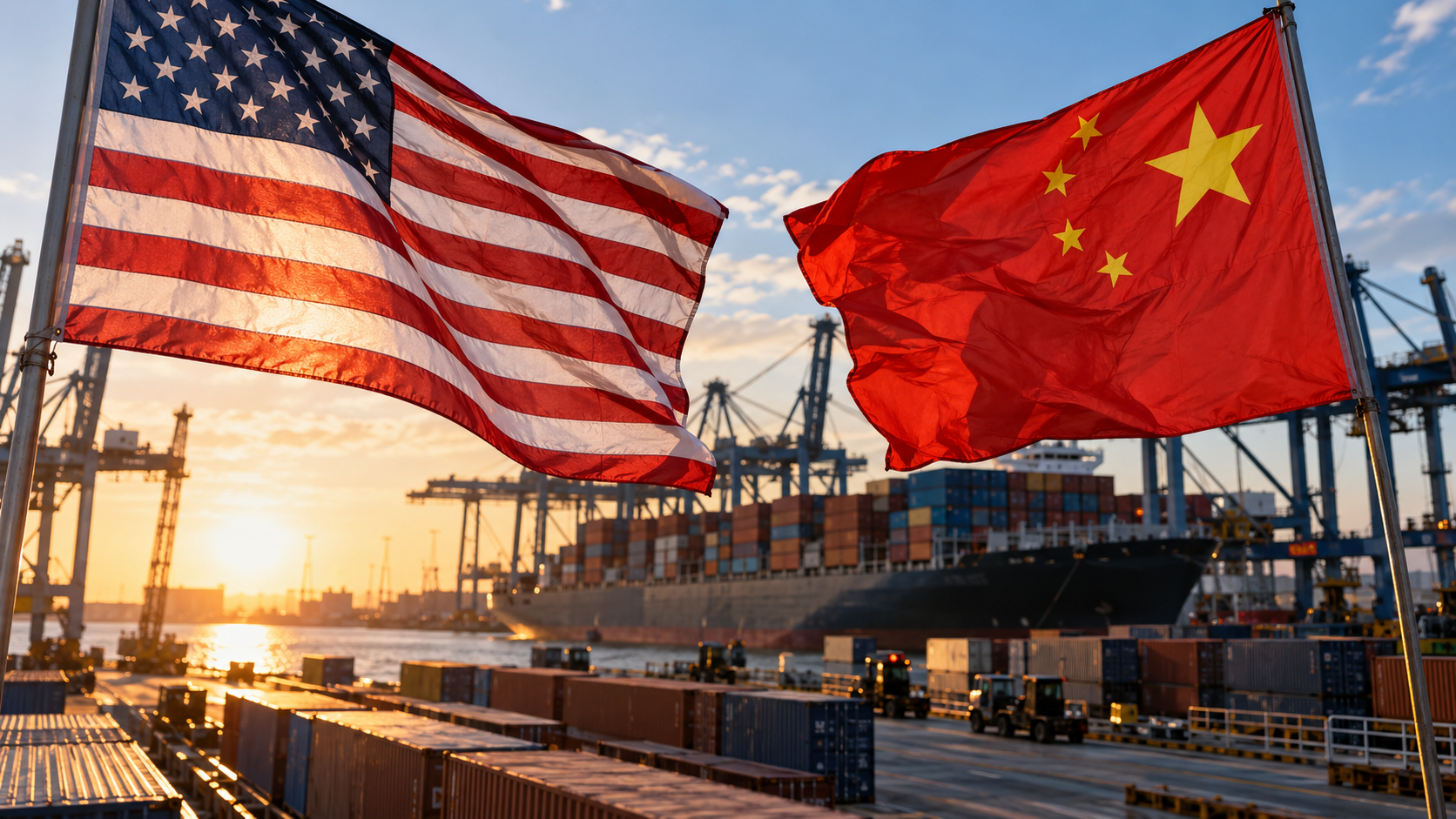
For Midwest companies, the U.S.-China trade war is not an abstract Washington policy issue. It can show up directly in the cost of machinery, electronics, industrial components, raw materials, agricultural exports, transportation contracts, supplier relationships, and ultimately the price of doing business.
That matters particularly across Illinois and the broader Midwest, where manufacturers, distributors, agricultural businesses, logistics companies, wholesalers, and growing middle-market companies often depend on international supply chains—even when they do not consider themselves "global" businesses.
More than eight years after the first major tariff actions of the current U.S.-China trade dispute, tariffs remain a significant part of the commercial relationship between the world's two largest economies.
The latest tariff tracking from the Peterson Institute for International Economics (PIIE) provides a striking snapshot. As of August 22, 2026, PIIE calculates that average U.S. tariffs on imports from China stand at 35.2% and cover approximately 89% of goods, while China's average tariffs on U.S. exports stand at 31.9% and cover 100% of goods.
For businesses, however, those headline percentages are only the beginning. The rate that actually applies to a shipment can depend on the product's tariff classification, country of origin, applicable Section 301 action, other sector-specific tariffs, exclusions, and the particular facts of the transaction.
If your company imports from China, uses Chinese-origin components, exports to China, or is reconsidering its global supply chain, this is a good time to determine where tariffs are actually affecting your costs and contracts. TEIL Firms can help Midwest businesses review that exposure before making sourcing, pricing, or expansion decisions.
The Latest U.S.-China Tariff Snapshot
PIIE's tariff tracker was originally published in 2019 and has been updated as the trade dispute has developed. Its August 2026 figures show just how far the trading relationship has moved from the tariff levels that existed before the dispute began in 2018.
According to PIIE:
Average U.S. tariff on Chinese goods: 35.2%
Share of Chinese goods covered: 89%
Average Chinese tariff on U.S. goods: 31.9%
Share of U.S. goods covered by Chinese tariffs: 100%
PIIE calculates that the average U.S. tariff on Chinese imports has increased by 14.4 percentage points since January 20, 2025, while China's average tariff on U.S. goods has increased by 10.7 percentage points over the same period.
Those averages are useful for understanding the scale of the trade dispute, but businesses should not treat 35.2% or 31.9% as universal tariff rates.
A particular product may face a significantly different rate—or several duties that apply under different legal authorities.
Why Midwest Businesses Should Pay Particular Attention
The Midwest sits at the intersection of several industries that can be directly affected by U.S.-China trade policy.
A manufacturer in Illinois, Indiana, Michigan, Ohio, or Wisconsin may rely on Chinese-origin electronics, machine parts, tooling, metals, chemicals, packaging, or finished components.
A food or agricultural business may be selling into China or relying on international demand that changes when retaliatory tariffs are imposed.
A distributor may import finished goods through coastal ports but warehouse and sell them throughout the Midwest.
A logistics company may never own the imported goods at all, yet still feel the effects when customers change sourcing locations, shipment volumes, routes, or inventory strategies.
And a growing Chicago-area company may discover that the cost assumptions used when it negotiated a supplier agreement six months ago no longer match the tariff environment today.
That is why Midwest businesses should not think of these tariffs as something relevant only to multinational corporations.
A company can be affected by U.S.-China trade policy simply because one important part, material, ingredient, or product in its supply chain originates in China.
How Did Tariffs Reach These Levels?
The current tariff structure is the result of several years of actions, negotiations, suspensions, increases, and targeted changes.
The dispute began in earnest in 2018, when the United States imposed additional tariffs following a Section 301 investigation into China's practices involving technology transfer, intellectual property, and innovation. China responded with its own tariffs on U.S. products.
By February 2020, U.S. tariffs on imports from China averaged approximately 19.3%, according to PIIE. At that point, the additional U.S. tariffs covered roughly two-thirds of imports from China. China's average tariff on U.S. products had reached approximately 21%.
The countries signed the Phase One Economic and Trade Agreement in January 2020. The agreement addressed areas including intellectual property, technology transfer, agriculture, financial services, and trade purchases, but much of the tariff structure remained in place.
During the Biden administration, the overall average tariff changed relatively little, although the United States increased tariffs in strategically important sectors. In 2024, for example, USTR finalized higher Section 301 tariffs affecting products including electric vehicles, batteries, semiconductors, solar cells, steel and aluminum products, critical minerals, medical products, and ship-to-shore cranes.
The tariff environment became considerably more volatile again in 2025 and 2026.
2025 Brought Much Larger Tariff Swings
PIIE's timeline illustrates just how quickly tariff exposure changed during 2025.
The United States implemented multiple rounds of new duties affecting Chinese imports. At one point in early May 2025, PIIE estimates that the average U.S. tariff on Chinese imports reached 126.1%.
China also increased tariffs in response, with its average tariff on U.S. imports reaching approximately 147.6% during April 2025.
Those extraordinarily high levels did not remain in place.
Following U.S.-China negotiations in Geneva, both countries reduced substantial portions of the additional tariffs. PIIE calculates that the average U.S. tariff fell to approximately 51.7% following those changes, with subsequent negotiations and tariff adjustments bringing the averages down further.
The result is today's unusual environment: tariffs are considerably below their 2025 peaks but remain dramatically higher than before the trade dispute began.
For Midwest companies making decisions about equipment, manufacturing, sourcing, or long-term supplier relationships, that volatility may matter just as much as the current tariff rate itself.
Another Important Change Came in 2026
The legal basis for portions of the U.S. tariff structure also changed in 2026.
PIIE reports that after the U.S. Supreme Court's February 2026 decision concerning tariffs imposed under the International Emergency Economic Powers Act (IEEPA), the Administration initially used Section 122 of the Trade Act of 1974 and later shifted to new Section 301 actions.
In July, USTR announced Section 301 actions covering dozens of trading partners following investigations concerning their treatment of imports produced with forced labor. China was among the economies included in those investigations. The resulting action imposed additional tariffs, subject to specified product exemptions and other rules.
This history illustrates an important compliance point:
Knowing that a product is "subject to China tariffs" is not enough.
Companies need to identify the legal authority, tariff list, applicable HTS classification, effective date, exclusion status, and any other duties that may apply.
A 35.2% Average Does Not Mean Your Product Has a 35.2% Tariff
This may be the most important distinction for businesses reading tariff headlines.
PIIE's figures are trade-weighted average tariff rates across large categories of goods. They are not a tariff schedule that businesses can apply directly to individual products.
The actual rate on an imported product begins with its classification under the Harmonized Tariff Schedule of the United States (HTSUS).
A Chinese-origin product may then be affected by:
its ordinary or Most-Favored-Nation duty rate;
Section 301 additional tariffs;
newer Section 301 actions;
Section 232 measures for certain products;
antidumping or countervailing duties where applicable; or
another product-specific trade measure.
Some products may also qualify for an exclusion or fall outside the scope of a particular action.
For a Midwest manufacturer importing hundreds of different parts, this becomes especially important. A company may have some components with minimal tariff exposure and others carrying substantial additional duties.
That is why tariff planning should begin with classification and product-level review, not with the headline percentage in a news article.
U.S.-China Trade Has Declined, but It Has Not Disappeared
USTR reports that U.S.-China goods trade totaled approximately $414.6 billion in 2025. U.S. goods exports to China were approximately $106 billion, while imports from China totaled approximately $308.7 billion. Total goods trade was about 29% lower than in 2024.
The International Trade Association of Greater Chicago recently highlighted the updated PIIE tariff figures in its Illinois International Business Calendar—an appropriate reminder that these developments have direct relevance to companies throughout Illinois and the Midwest.
The trade relationship remains particularly important because many companies in the region sit somewhere in the middle of a larger global supply chain.
A business may not import directly from China but may buy from a domestic supplier whose products contain Chinese components.
A contract manufacturer may use imported machinery or electronics.
A distributor may source finished products through a U.S. intermediary.
An agricultural or food business may be affected by Chinese tariffs on U.S. exports even though it imports nothing from China.
For some companies, replacing a Chinese supplier may be relatively straightforward. For others, the cost, production capability, tooling, intellectual property, quality-control requirements, or scale of the relationship may make rapid relocation impractical.
Tariffs Can Affect More Than the Customs Bill
The immediate effect of a tariff appears at importation, but the business consequences can move throughout the transaction.
A higher duty may affect:
landed product cost;
manufacturing expenses;
wholesale and retail pricing;
profit margins;
supplier negotiations;
inventory decisions;
purchase commitments;
distributor agreements; and
customer contracts.
For Midwest manufacturers in particular, even a relatively small tariff increase on a frequently used component can multiply across thousands of units of production.
Businesses should also determine who is contractually responsible for those costs.
If an Illinois company agreed to buy products from a Chinese supplier before the tariff changed, can the price be adjusted?
Who is the importer of record?
Does the agreement specify responsibility for tariffs and customs duties?
Does a change-in-law provision apply?
Can either party terminate or renegotiate?
What Incoterm governs the transaction?
These questions become particularly important when tariff rates change after a contract has already been signed.
Supply-Chain Diversification Requires More Than Finding Another Factory
The prolonged U.S.-China trade dispute has encouraged many companies to reconsider where products are manufactured and sourced.
For Midwest companies, diversification may involve looking to Mexico, Canada, Southeast Asia, India, Europe, or even expanding domestic production.
But relocating production does not automatically eliminate tariff exposure.
Country-of-origin rules matter.
Moving limited assembly or processing from China to another country may not necessarily change the product's legal origin for U.S. customs purposes. Companies restructuring a supply chain should evaluate whether the manufacturing activity in the new jurisdiction is sufficient under applicable origin rules before assuming that China-related duties no longer apply.
Businesses should also consider whether the new country presents different customs, sanctions, export-control, labor, intellectual property, logistics, tax, or contractual risks.
A supply-chain move that solves one tariff issue but creates three new compliance problems may not ultimately reduce business risk.
What Midwest Businesses Should Be Doing Now
Companies with exposure to U.S.-China trade do not necessarily need to abandon existing suppliers or restructure their entire operations.
They should, however, understand exactly where tariff risk sits within the business.
A practical review should include:
Confirm your HTS classifications. Determine which tariff provisions actually apply to the products your company imports.
Map Chinese-origin components. Look beyond direct suppliers. Determine whether critical parts, materials, or ingredients originate in China farther down the supply chain.
Calculate the complete landed cost. Include ordinary duties, Section 301 tariffs, transportation, brokerage, and other applicable charges.
Review supplier and customer contracts. Identify provisions addressing tariffs, customs duties, price adjustments, changes in law, force majeure, termination, and Incoterms.
Stress-test margins. Midwest manufacturers and distributors should model what happens if tariff rates increase again rather than evaluating only today's rate.
Evaluate alternative sourcing. Determine whether realistic suppliers exist in other markets and what would be required to transition production.
Protect intellectual property before moving production. Expanding or relocating manufacturing can expose trademarks, designs, formulas, processes, and other IP in additional jurisdictions.
Review export exposure. Agricultural, manufacturing, and other businesses selling into China should examine Chinese retaliatory tariffs as carefully as U.S. import duties.
Monitor exclusions and tariff changes. The U.S.-China tariff structure has changed repeatedly, sometimes within weeks or months.
The TEIL Perspective
For Midwest businesses, the lesson from eight years of U.S.-China tariff changes is not simply that tariffs are high.
It is that international trade strategy is now part of ordinary business planning.
A Chicago manufacturer sourcing components overseas, an Illinois food company selling internationally, a regional distributor importing finished goods, or a growing Midwest company considering its first foreign market may all face some version of the same question:
How do we grow internationally without allowing one change in trade policy to disrupt the business?
For one company, the answer may begin with correcting an HTS classification.
For another, it may involve renegotiating a supplier agreement, identifying manufacturing alternatives, reviewing country-of-origin rules, protecting intellectual property in a new jurisdiction, or developing a broader market-diversification strategy.
Those decisions should be connected.
A company's customs strategy, contracts, supply chain, intellectual property portfolio, and international expansion plans all affect one another.
TEIL Firms assists Illinois and Midwest businesses with international trade and regulatory compliance, cross-border contracts, intellectual property protection, and global expansion strategy. If your company imports from China, sells into China, relies on Chinese-origin products or components, or is considering moving part of its supply chain, we can help assess the legal and strategic considerations before you make the next move.
Source Credit
This article was prompted by the International Trade Association of Greater Chicago's October 5, 2026 Illinois International Business Calendar, which highlighted the updated U.S.-China tariff tracker maintained by the Peterson Institute for International Economics.
TEIL Firms independently reviewed the PIIE data and relevant U.S. government materials and prepared this original analysis. No language, chart design, or proprietary commentary from PIIE or the International Trade Association of Greater Chicago has been reproduced.
The PIIE tariff figures discussed above are current through August 22, 2026. PIIE notes that its tariff chart does not include antidumping or countervailing duties, which can create additional exposure for particular products. This article is provided for informational purposes only and does not constitute legal advice.