
ESG Reporting Is Converging Around ISSB and TCFD—But Most Companies Are Still Rebuilding the Same Report Repeatedly
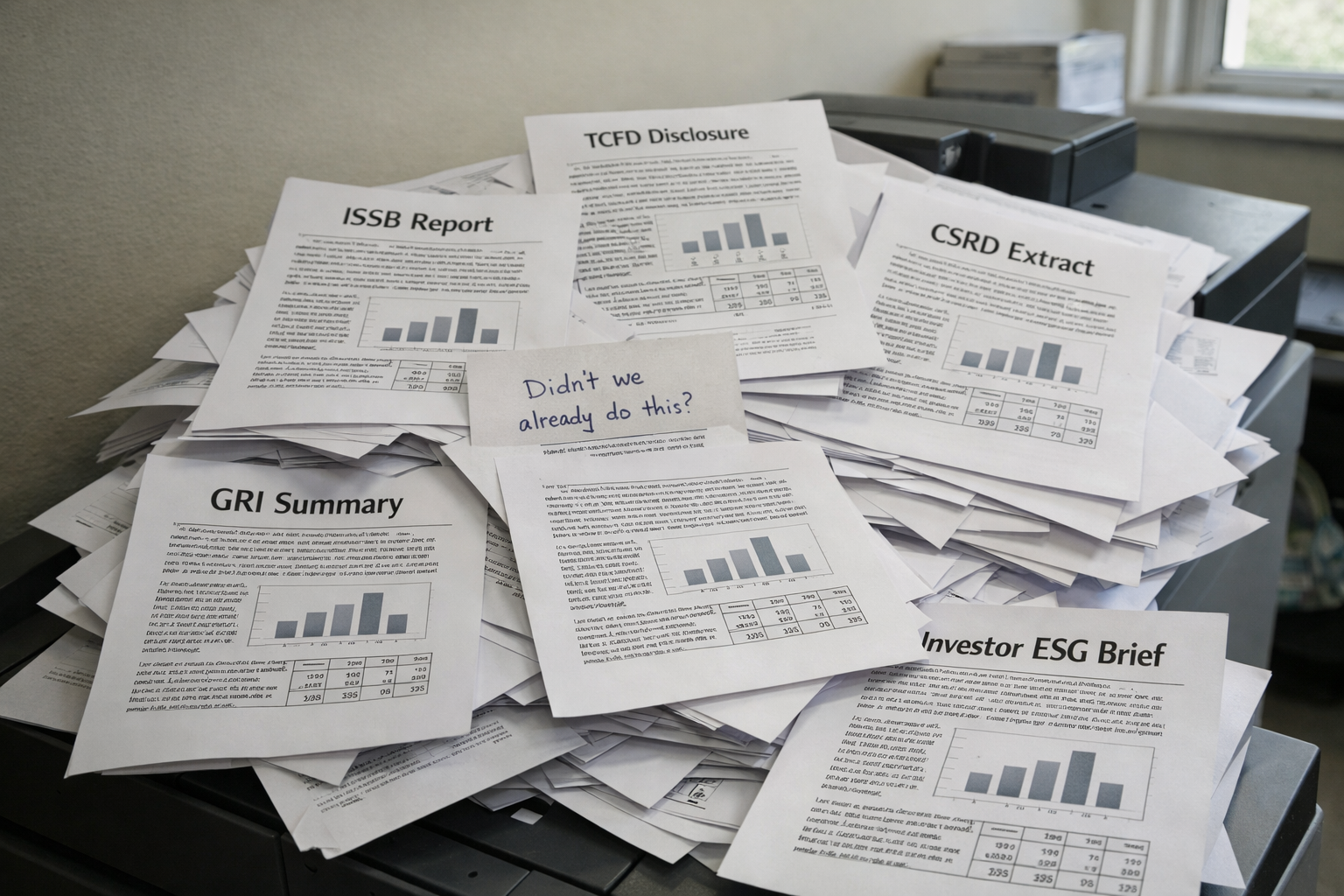
One of the most important ESG developments in 2026 is not a new reporting obligation.
It is the quiet convergence of reporting logic itself.
Across jurisdictions, the market is increasingly crystallizing around comparable disclosure architecture built on ISSB, IFRS S1 and S2, TCFD-style governance structures, UK sustainability standards, and sector-aligned overlays. Even where legal mandates differ by region, the underlying logic is becoming far more interoperable: governance, strategy, risk management, metrics, targets, and materiality pathways are beginning to speak the same language. (ifrs.org)
That should make reporting easier.
For many companies, it has done the opposite.
The real problem is no longer uncertainty over which framework exists. It is the operational burden of translating the same sustainability evidence into multiple frameworks every quarter, every diligence cycle, and every board reporting season. A company may already have the underlying climate data, governance minutes, supplier diligence, workforce metrics, and materiality assessments. Yet those same facts are still being manually rebuilt into different formats for CSRD, ESRS, GRI, ISSB, SASB, TCFD, lender questionnaires, and customer procurement portals.
That duplication is becoming one of the most expensive hidden costs in ESG compliance.
The leadership frustration is understandable. Teams are not failing to produce data. They are being forced to retell the same data story repeatedly through different disclosure grammars. One quarter the board wants TCFD-style climate governance. The next a lender asks for ISSB-aligned financial materiality. A strategic customer wants GRI-style supplier impact metrics. A UK entity needs a slightly different governance sequencing. The result is that the business is not building a data room.
It is rebuilding a narrative every time.
That is why the most strategic ESG question in 2026 is no longer “What framework applies?”
It is how many times should the same evidence have to be rebuilt before the system itself becomes the risk?
This is where framework convergence should be creating competitive advantage.
The global move toward ISSB and TCFD-style architecture means that companies now have a real opportunity to build one defensible evidence layer that maps into multiple frameworks instead of recreating separate workflows for each audience. IFRS Foundation adoption momentum is making this even more important as multinational businesses, PE-backed platforms, and cross-border supply chains increasingly face overlapping disclosure expectations that all rely on the same core governance and metrics structure. (ifrs.org)
The legal risk is not merely inefficiency.
It is inconsistency.
The moment the same climate metric, workforce data point, or governance statement appears differently across ISSB, CSRD, TCFD, or investor reporting, the company begins to create discovery risk, diligence friction, and possible greenwashing exposure. The more often the team manually rebuilds the report, the more likely version drift, threshold mismatches, and unsupported language begin to appear.
This is exactly where TEIL’s ESG platform can own the market narrative.
The future of ESG readiness is not choosing one framework.
It is mapping one controlled data room across multiple standards without rebuilding the report every quarter.
That is why your framework dropdown concept is so commercially strong. The app should allow companies to preserve one legal-grade evidence architecture and then map the same underlying controls across CSRD / ESRS, GRI, ISSB, SASB, TCFD, UK standards, and sector-specific overlays without duplicating the workflow. Instead of separate reporting silos, the business builds one source of defensible truth and deploys it where the market demands it.
That is where reporting maturity becomes scalable.
For boards, sustainability leaders, CFOs, PE-backed platforms, and cross-border companies, now is the time to evaluate whether your ESG reporting process is creating unnecessary duplication risk. A focused legal and systems review often reveals where framework overlap, version drift, and evidence inconsistencies are forcing teams to rebuild the same report in multiple ways before those inefficiencies become diligence failures, investor confusion, or disclosure exposure. If your organization is managing multiple ESG frameworks, this is the ideal moment to schedule a framework-alignment consultation and pre-register for TEIL’s ESG compliance platform, designed to map one evidence data room across ISSB, TCFD, CSRD, GRI, and sector overlays without rebuilding your ESG report every quarter.