
The U.S.–Canada Trade War Is No Longer Just a Border Issue: What U.S. Businesses Need to Prepare For
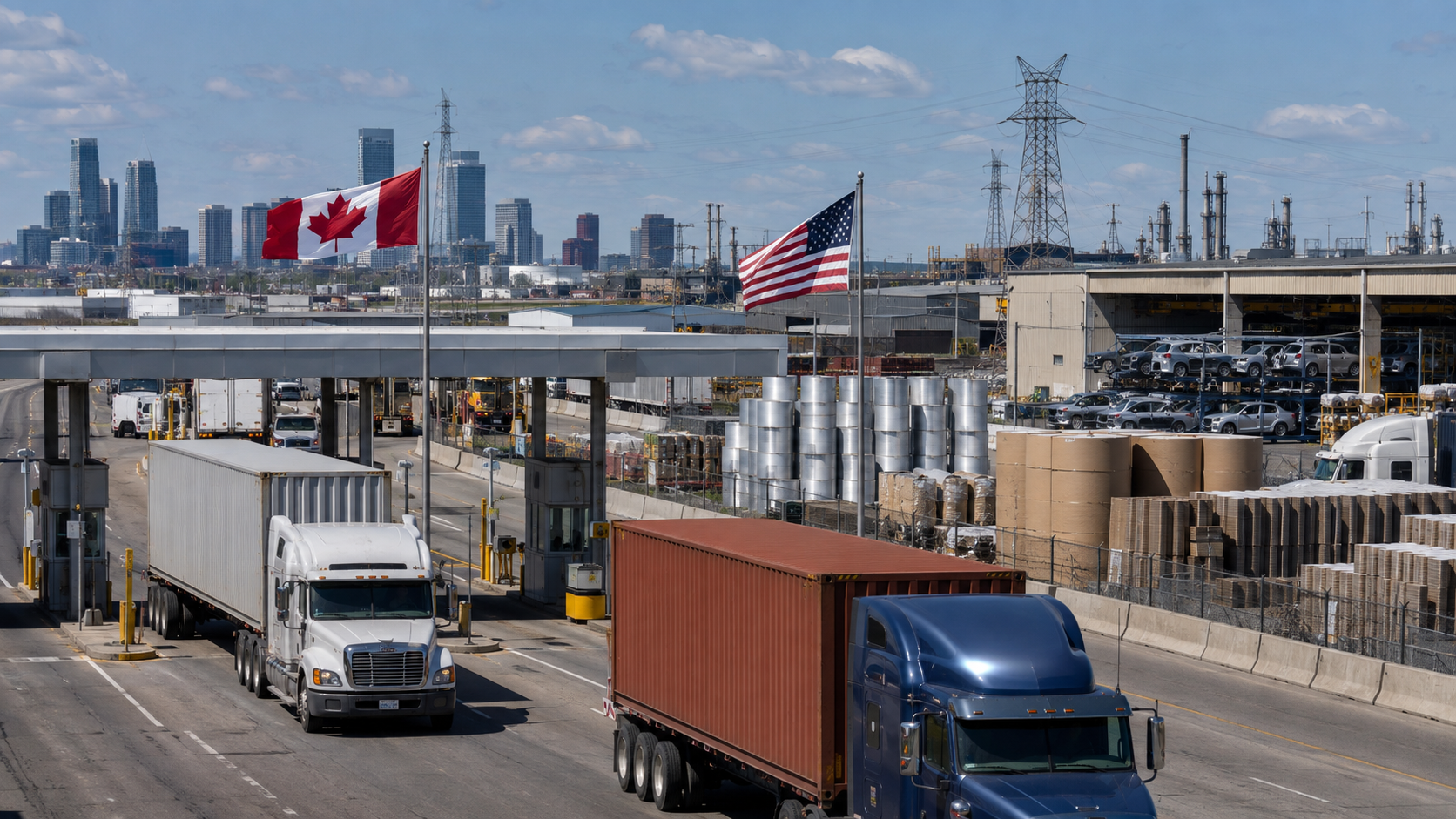
From automotive manufacturing and aluminum to packaging, agriculture and energy, escalating tariffs between the United States and Canada could create consequences far beyond the companies that directly import or export across the border.
For decades, the United States and Canada have operated one of the most deeply integrated commercial relationships in the world. Raw materials, automotive components, agricultural products, packaging materials, energy and finished goods routinely move between the two countries—sometimes crossing the border multiple times before reaching the end consumer.
That integration is precisely what makes the rapidly escalating U.S.–Canada trade dispute so significant for American businesses.
The latest escalation came after trade negotiations between the two countries broke down in August. According to the Canadian government, the United States imposed 50% tariffs on approximately C$27.6 billion in Canadian goods beginning August 22, 2026. Canada responded by announcing reciprocal tariffs of 15%, 25% and 50% on approximately C$27.6 billion of U.S. products, scheduled to take effect September 8, 2026.
Canada's countermeasures encompass approximately 700 products and concentrate heavily on sectors including steel and aluminum, dairy, appliances, agricultural equipment, pulp and paper, plastics and electronics. Reuters characterized the move as a dollar-for-dollar response to the new U.S. duties.
For U.S. companies, the important question is no longer simply, “Do we sell products in Canada?”
Businesses should also be asking:
Do our suppliers buy Canadian materials? Do our products contain Canadian components? Does our packaging depend on Canadian fiber or aluminum? Do our customers sell into Canada? Could our transportation, energy or manufacturing costs increase because another company in our supply chain is affected?
Those questions reveal the real reach of a trade war.
Why Canada Matters So Much to U.S. Business
Canada is not a minor export market.
U.S. Trade Representative data reports that total U.S.–Canada goods and services trade reached approximately $872.3 billion in 2025. U.S. companies exported approximately $333.6 billion in goods to Canada, in addition to approximately $92.3 billion in services.
Canada has consistently ranked among the United States' two largest trading partners, and the USTR specifically identifies automotive manufacturing, textiles and energy as examples of the countries' highly integrated supply chains.
That means tariffs imposed at the border can travel much farther than the border itself.
A manufacturer that has never directly imported something from Canada may still purchase equipment containing Canadian steel.
A food company may use aluminum cans manufactured from Canadian metal.
A retailer may purchase products shipped in corrugated packaging affected by higher pulp and paper costs.
An auto supplier may sell a component to another U.S. manufacturer whose production depends on parts crossing the Canadian border.
And businesses in certain parts of the country may ultimately experience increased energy costs if trade tensions expand into electricity or other energy resources.
Several industries therefore deserve particularly close attention.
1. Automotive and Auto Parts: An Integrated Industry Faces Major Uncertainty
Few industries demonstrate the interconnectedness of the U.S. and Canadian economies as clearly as automotive manufacturing.
Vehicles assembled in North America may contain parts manufactured in multiple countries, and components can cross the U.S.–Canada border several times during production.
Automotive trade was already subject to tariffs before the latest escalation. Canada currently imposes 25% tariffs on certain U.S. vehicles, including non-CUSMA/USMCA-compliant vehicles and certain non-Canadian and non-Mexican content within qualifying vehicles.
The dispute became even more consequential in August when President Trump threatened to increase U.S. tariffs on Canadian cars, trucks, automotive parts and steel to 50% beginning January 1, 2027. Industry reporting has consequently raised concerns about investment decisions and the future structure of North American automotive production.
The implications extend well beyond automobile manufacturers.
Potentially exposed U.S. businesses include:
auto-parts manufacturers;
plastics and polymer suppliers;
steel and aluminum fabricators;
electronics manufacturers;
trucking and logistics companies;
dealerships;
repair and collision businesses;
equipment manufacturers; and
companies supplying machinery, tooling or materials to automotive plants.
The greatest problem may be uncertainty.
Major manufacturing investments are made years in advance. Companies deciding where to locate a plant, purchase equipment, source components or expand production must now consider whether a historically integrated North American supply chain will continue operating under the same economics.
For smaller suppliers, those decisions can be just as consequential. A change made by one large automaker can ripple through dozens or hundreds of companies further down the supply chain.
2. Steel and Aluminum: Tariffs That Can Travel Through the Entire Economy
Metals may produce some of the most immediate downstream effects.
Beginning September 8, Canada's new countermeasures include tariffs reaching 50% on certain U.S. steel and aluminum products, while U.S. tariffs also affect metals and related Canadian products.
The problem for U.S. businesses is America's continuing reliance on Canadian metal.
Food Dive's August 27 analysis of the packaging industry reports that Canada supplies approximately two-thirds of the primary aluminum used in the United States, citing the Aluminum Association. The publication also notes that U.S. can manufacturers import nearly 80% of the tin mill steel used in food cans.
This makes metal tariffs more than an issue for steel mills.
Higher metal costs can ultimately affect businesses producing:
automobiles and trucks;
food and beverage cans;
machinery;
construction products;
HVAC systems;
appliances;
electronics;
industrial equipment;
furniture;
consumer products; and
packaging.
And domestic production cannot necessarily expand quickly enough to replace imported supply.
That creates a common tariff dilemma: even companies that support expanding American manufacturing may face substantial near-term costs while additional domestic capacity is being developed.
3. Packaging: The Industry Almost Every Other Industry Uses
Packaging may be one of the most overlooked areas of exposure.
Canada's counter-tariffs specifically target categories including pulp and paper, while metals tariffs affect aluminum and steel packaging.
Food Dive reports that industry organizations are warning that the U.S. pulp, paper, packaging and tissue supply chain is deeply integrated across North America. The Canadian Corrugated and Containerboard Association has similarly warned that disrupting corrugated and containerboard trade could create consequences far beyond packaging manufacturers because virtually every physical product must eventually be packaged or transported.
That is what makes packaging costs particularly important.
A tariff on packaging does not remain a packaging-industry problem.
It can become an additional cost for:
food manufacturers;
beverage businesses;
pharmaceutical companies;
cosmetics companies;
e-commerce sellers;
retailers;
manufacturers;
consumer-goods companies;
agricultural businesses; and
exporters.
A company could therefore avoid every product specifically named in the tariff orders and still experience higher costs because the box, container, can, pallet or material used to sell and transport its product becomes more expensive.
For businesses already operating on narrow margins, several seemingly modest increases—packaging, transportation, raw materials and energy—can become significant when combined.
4. Agriculture, Food and Beverage: U.S. Exporters Could Lose Competitiveness
Agriculture is another particularly exposed sector.
Canada's September countermeasures include products involving dairy, agricultural equipment, fish and seafood, along with numerous other goods.
Canada is also an enormously important customer for American agriculture. According to USTR, U.S. exports to Canada include more than $30 billion in agricultural products, including cereals and pasta, baked goods, vegetables, fruit and ethanol.
When Canada places additional duties on U.S. products, American exporters face a straightforward commercial problem: their goods may become more expensive for Canadian customers.
That can cause Canadian buyers to:
seek domestic suppliers;
negotiate lower prices with American vendors;
change sourcing countries;
reduce order quantities; or
delay purchasing decisions while waiting for the dispute to stabilize.
Once a customer develops a new supplier relationship, however, removing the tariff does not necessarily bring that customer back.
That makes prolonged trade disputes particularly dangerous for exporters. The long-term risk is not simply paying a tariff today—it is potentially losing market share tomorrow.
Food and beverage companies face additional complications because packaging, aluminum, glass, transportation and agricultural inputs may themselves be affected.
5. Pulp, Paper, Forestry and Consumer Goods: Supply-Chain Costs Can Compound
Pulp, paper and wood products have emerged as another central area of concern.
Canada's countermeasures specifically include U.S. pulp and paper products, while U.S. measures have also targeted Canadian wood and paper categories.
For businesses directly operating in forestry, paper manufacturing or packaging, the exposure is obvious.
But downstream exposure is much broader.
Paper products are used in shipping, labeling, food service, retail packaging, office products, publishing and countless manufacturing applications. Manufacturers may consequently find themselves paying more for both their product inputs and the materials required to package and distribute the finished product.
This illustrates one of the most difficult aspects of tariff-driven inflation: costs can accumulate at multiple points in the same transaction.
6. Electronics, Appliances and Manufacturing Equipment
Canada's September tariff list also targets electronics, appliances, tools and agricultural equipment.
For American manufacturers, this creates two distinct risks.
The first is export risk. A U.S.-manufactured product entering Canada may suddenly become substantially more expensive relative to a Canadian or non-U.S. alternative.
The second is supply-chain risk. Manufacturers purchasing Canadian parts, components or materials may encounter higher costs on the U.S. side of the border.
Businesses involved with machinery, industrial equipment, electronics, appliance manufacturing and related distribution should therefore examine not merely where their finished products are manufactured, but where the underlying components originate.
7. Energy: The Risk Businesses Should Not Ignore
Energy is somewhat different from the categories above.
Current tariff measures do not mean Canadian electricity is suddenly subject to the same tariff treatment as every targeted manufactured product. But increasing political tension has raised concerns that energy could become another source of economic leverage.
That matters particularly for states that rely heavily on Canadian energy.
Reporting from WCAX/WWNY-TV found that approximately 22% of New York's electricity imports come from Canada. The recently completed $6 billion Champlain Hudson Power Express line from Quebec is expected to provide approximately one-fifth of New York City's electricity.
Utility officials told the station that energy demand is expected to remain available, but that reductions in Canadian exports could primarily be felt through higher wholesale electricity prices.
Businesses in New York, New England and other northern states should therefore pay attention to the trade dispute even if they neither import nor export physical goods.
For energy-intensive industries—manufacturing, warehousing, data operations, food production and cold storage among them—even relatively modest changes in electricity prices can materially affect operating costs.
The Bigger Risk: A Tariff Can Reach a Business Without Appearing on Its Customs Bill
The most important lesson for U.S. businesses is that tariff exposure is not limited to the importer of record.
Consider a U.S. company that purchases a domestically manufactured product.
Its supplier imports Canadian aluminum.
The supplier's packaging company uses Canadian paper.
The trucking company faces increased equipment costs.
The customer's Canadian distributor becomes subject to retaliatory tariffs.
And the manufacturing plant operates in a region exposed to Canadian electricity pricing.
The U.S. company may never personally pay a tariff at Customs.
It can nevertheless experience the economic consequences through supplier price increases, reduced margins, lost customers, contract disputes and changing market conditions.
That is why businesses should approach the current dispute as a broader commercial-risk issue rather than merely a customs issue.
What U.S. Businesses Should Be Doing Now
Businesses do not need to predict the next political announcement. They do need to understand their exposure.
1. Map Your Canadian Exposure
Identify:
Canadian suppliers;
Canadian customers and distributors;
Canadian-origin raw materials;
components containing Canadian inputs;
U.S. suppliers dependent on Canadian materials; and
products exported directly or indirectly into Canada.
Go at least one level beyond your immediate suppliers whenever practical.
2. Review Product Classifications and Country of Origin
Tariffs apply according to specific product classifications and origin rules—not simply because a business "does business with Canada."
Businesses should confirm:
Harmonized System/HTS classifications;
country-of-origin determinations;
USMCA/CUSMA eligibility;
supporting certificates and supplier documentation; and
customs valuation practices.
A classification mistake during a volatile tariff environment can become expensive quickly.
3. Review Who Is Contractually Responsible for Tariffs
Do not assume the other party must absorb the additional cost.
Review existing agreements for provisions governing:
customs duties and taxes;
tariff allocation;
pricing adjustments;
change in law;
Incoterms;
importer-of-record responsibility;
delivery obligations;
cost escalation;
termination rights; and
renegotiation or hardship mechanisms.
Businesses should also be cautious about automatically treating a tariff as a force majeure event. Whether a tariff permits nonperformance depends heavily on the actual contract language and applicable law.
4. Reevaluate Pricing Before Margins Disappear
Companies should model several scenarios.
What happens if input costs increase 10%?
25%?
50%?
Can prices be adjusted immediately?
Does a customer contract lock pricing for another year?
Does the company have minimum-volume obligations?
Can alternative suppliers realistically meet specifications?
Those calculations should happen before a shipment arrives—not after the margin is gone.
5. Examine New Contracts Differently
The current dispute is another reminder that international contracts should address what happens when governments change the economics of a transaction.
Businesses entering or renewing cross-border agreements should consider expressly allocating responsibility for:
tariffs;
customs duties;
retaliatory measures;
regulatory changes;
transportation disruptions;
currency changes;
alternative sourcing; and
extraordinary cost increases.
6. Develop an Alternative-Supplier Strategy—But Do Not Abandon Existing Relationships Too Quickly
Diversification may reduce risk, but changing suppliers carries its own legal and commercial consequences.
Businesses should consider quality requirements, intellectual-property protections, existing exclusivity agreements, minimum purchase commitments, termination provisions, lead times, regulatory requirements and the cost of qualifying new vendors before making abrupt sourcing changes.
The Bottom Line
The economic relationship between the United States and Canada was built around integration. The current trade dispute is testing what happens when tariffs are inserted into supply chains designed around relatively frictionless cross-border commerce.
The companies most visibly exposed are in automotive manufacturing, steel and aluminum, packaging, pulp and paper, agriculture, food and beverage, electronics, appliances and industrial equipment.
But the ultimate impact is likely to extend considerably further.
For U.S. businesses, the objective should not be to guess whether Washington and Ottawa will eventually reach another agreement. Trade policy can change quickly.
The better strategy is to know where your business is exposed, what your contracts actually require, who bears additional costs, what alternative sourcing options exist and how much tariff pressure your margins can absorb.
In an unpredictable trade environment, legal and commercial preparedness may be one of the few variables a business can actually control.
Sources & Further Reading
Government of Canada, Department of Finance. “Canada Announces Targeted Countermeasures and Substantive Support for Workers and Businesses in Response to U.S. Tariffs,” Aug. 25, 2026.
Read the Government of Canada announcement
Government of Canada, Department of Finance. “List of Products from the United States Subject to Counter-Tariffs Effective September 8, 2026,” Aug. 25, 2026.
View Canada's tariff list
Pyzyk, Katie. Food Dive/Packaging Dive. “Packaging Industry Braces for Impacts from U.S.-Canada Trade War,” Aug. 27, 2026.
Read the Food Dive article
LaShomb, Alek. WCAX/WWNY-TV. “US-Canada Trade Fight Sparks Energy Cost Fears in North Country,” Aug. 26, 2026.
Read the WWNY-TV article
Mukherjee, Promit. Reuters. “Canada Announces Retaliatory Tariffs on $20 Billion Worth of U.S. Goods, Unveils Support Measures,” Aug. 25, 2026.
Read the Reuters report
Plastics News. “Spiraling U.S.-Canada Trade War Puts Auto Investments in Limbo,” Aug. 27, 2026.
Read the Plastics News article
Office of the United States Trade Representative. “Canada.” Trade and investment data.
The White House. Presidential actions concerning additional duties on certain Canadian motor vehicles and other products, July 2026.
This article is provided for general informational purposes and does not constitute legal advice. Tariff applicability, customs treatment and contractual responsibility depend on the particular product, transaction, agreement and circumstances involved.