
The EU’s New Steel Rules: Why Country of Origin May No Longer Be Enough
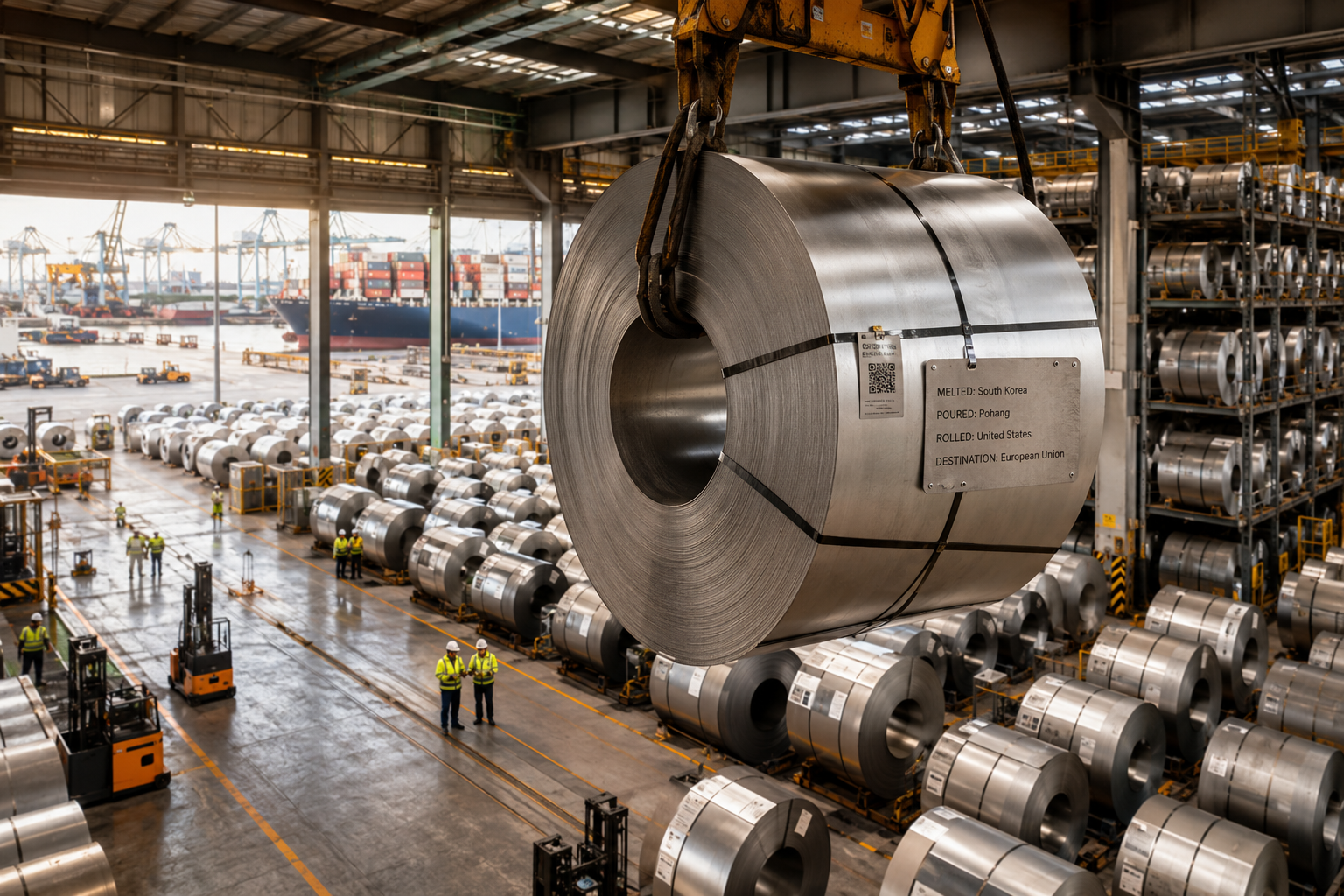
Beginning July 1, the European Union will sharply reduce duty-free steel quotas and impose a 50% duty on covered imports above those limits. U.S. businesses must also prepare to document where the steel was originally melted and poured.
A major change in European steel trade takes effect on July 1, 2026.
The European Union is replacing its existing steel safeguard with a new tariff-rate quota system designed to protect European producers from global excess capacity and trade diversion.
The new regulation will:
Limit annual duty-free steel imports to approximately 18.3 million metric tonnes;
Reduce tariff-free import volumes by about 47% compared with the EU’s 2024 safeguard quotas;
Impose a 50% duty when an applicable quota is exhausted or unavailable;
Apply to covered steel from nearly all non-European Economic Area countries;
Require importers to document where the steel was originally melted and poured; and
Permit the European Commission to reconsider the product scope and quota levels as trade conditions change.[1]
For U.S. businesses, this is not merely a European steel-industry story.
The new rules may affect:
U.S. steel producers exporting to Europe;
Manufacturers selling steel-intensive goods;
Companies using European distributors;
U.S. businesses sourcing foreign steel;
Construction, automotive, energy, machinery, aerospace, rail, and infrastructure companies;
Suppliers providing steel to products later exported to Europe;
Companies relying on EU tariff quotas in long-term pricing arrangements; and
Businesses facing increased competition from steel diverted away from Europe.
The commercial lesson is significant:
Knowing the legal country of origin of steel may no longer provide all the information needed to enter the European market.
A product may be rolled, coated, cut, finished, or exported from the United States while the raw steel was originally melted and poured in another country. The EU will increasingly require visibility into that earlier stage of production.
That distinction changes how companies should approach customs documentation, supplier contracts, tariff planning, recordkeeping, and supply-chain due diligence.
What the New EU Steel Regulation Does
The European Union has maintained steel safeguards since 2019. Those measures were adopted in response to concerns that trade restrictions in other markets—including U.S. steel measures—would redirect steel into Europe and threaten European producers.
The existing safeguard expires on June 30, 2026.
Regulation (EU) 2026/1384 replaces it with a new framework beginning July 1.[1]
The regulation establishes annual tariff-rate quotas for designated categories of steel products. Covered goods may enter without the new 50% out-of-quota duty while the relevant quota remains available.
Once that quota is exhausted—or where the import does not benefit from an available quota—the covered merchandise becomes subject to a 50% ad valorem duty.
An ad valorem duty is calculated as a percentage of the goods’ customs value.
For example, if a covered shipment has a customs value of €500,000 and no quota is available:
€500,000 × 50% = €250,000
The new out-of-quota duty would therefore equal €250,000.
That amount may be imposed in addition to other applicable duties and import costs.
Depending on the merchandise and country, the importer may also need to account for:
Ordinary customs duties;
Antidumping duties;
Countervailing duties;
Carbon Border Adjustment Mechanism obligations;
Customs brokerage;
Transportation;
Insurance;
Storage;
Testing;
Certification; and
Other compliance costs.
A product that is commercially viable within quota may become uneconomical once the quota is exhausted.
What Is a Tariff-Rate Quota?
A tariff-rate quota allows a specified quantity of merchandise to enter at one tariff level while imposing a higher tariff on quantities exceeding the quota.
It is not necessarily an absolute prohibition against imports.
Covered steel may still be imported after the applicable quota is exhausted, but the 50% out-of-quota duty may make the transaction commercially unattractive.
The EU’s annual quota period will run from July 1 through June 30 of the following year.
The total initial annual quota is 18,345,922 metric tonnes. That total is divided among different steel product categories and then allocated among supplying countries through European Commission implementing measures.[2]
The quotas will be administered quarterly.
During the first year, unused quota volume from one quarter may carry forward to the next quarter within the same annual period. Beginning with the second year, the European Commission will determine whether carryover should continue for particular categories based on factors including quota usage, import pressure, and supply availability for European downstream industries.
This means quota availability may depend on:
The product category;
The exporting country;
The quarter of entry;
Prior quota usage;
Whether unused volume carries forward;
Whether a bilateral safeguard applies;
Whether the Commission adjusts quota allocation; and
The timing of customs acceptance.
A purchase agreement signed while quota remains available does not necessarily reserve that quota for a future shipment.
Businesses must understand who bears the risk if the quota is exhausted before the goods are entered into the EU.
Which Products Are Covered?
The regulation covers a broad range of flat and long steel products identified by specific Combined Nomenclature and TARIC codes.
Covered categories include various:
Hot-rolled sheets and strips;
Cold-rolled sheets;
Electrical steel;
Metallic-coated sheets;
Organic-coated sheets;
Tin mill products;
Quarto plates;
Stainless sheets and strips;
Merchant bars and light sections;
Rebar;
Stainless bars;
Wire rod;
Angles, shapes, and sections;
Sheet piling;
Railway materials;
Gas pipes;
Hollow sections;
Seamless tubes and pipes;
Welded tubes;
Cold-finished bars; and
Non-alloy wire.[2]
The commercial name of a product does not determine whether it is covered.
The applicable legal classification depends on the product’s objective characteristics, including matters such as:
Composition;
Alloy content;
Dimensions;
Shape;
Manufacturing process;
Surface treatment;
Intended use where legally relevant; and
Condition at importation.
A company should not assume that a product is outside the regulation merely because it is described commercially as a component, specialized material, fabricated item, or proprietary product.
The Combined Nomenclature classification controls.
The Product Scope May Expand
The current regulation is not necessarily the final boundary of EU steel protection.
The European Commission must conduct several reviews of the product scope.
By the end of 2026, it must assess whether specified additional tube, wire, and forged-bar classifications should be included.
By June 30, 2027, it must evaluate whether the regulation should extend to additional products made from or containing significant amounts of steel.
Additional reviews are scheduled for later years.[3]
This is important for U.S. manufacturers of downstream products.
A finished machine, fabricated structure, automotive component, appliance, tool, fastener, or other steel-containing article may not fall within the initial steel quota system.
But the EU has expressly reserved the possibility of extending the measure to downstream articles if officials conclude that foreign steel is circumventing the regulation by entering Europe as a more highly processed product.
Businesses should therefore avoid assuming that only primary steel producers need to monitor the rule.
The Regulation Applies Even to Many Free-Trade Partners
The EU’s new tariff-rate quota framework generally applies to covered imports from third countries even when the EU has a free-trade agreement with the exporting country.
The regulation allows the European Commission to use bilateral safeguard measures where appropriate under the particular trade agreement. If no separate bilateral safeguard applies, covered products from the free-trade partner may remain subject to the quota system and out-of-quota duty.
Products originating in Iceland, Liechtenstein, and Norway are excluded from the tariff quotas and 50% out-of-quota duty because of their integration within the European Economic Area.
The United States does not receive that EEA exclusion.
A U.S. exporter must therefore identify:
Whether its product is covered;
Whether the United States has an allocated quota for the category;
How much of that quota remains;
Whether another country’s quota is relevant;
Which quarter controls;
Whether other duties apply; and
What documentation the EU importer needs.
Preferential tariff treatment under another legal arrangement does not necessarily displace the steel regulation.
The 50% Duty Is Not the Same as an Antidumping Duty
The new out-of-quota duty operates separately from antidumping and countervailing duties.
Antidumping duties address findings that particular foreign merchandise is being sold below the legally determined fair value and is injuring an EU industry.
Countervailing duties address specified government subsidies that injure an EU industry.
The steel quota measure is broader. It responds to global overcapacity and import pressure rather than requiring the same product-, country-, and exporter-specific findings associated with an antidumping or countervailing-duty investigation.
A product may therefore be subject to more than one trade measure.
For example, covered steel could potentially face:
The ordinary EU customs duty;
A 50% out-of-quota steel duty;
An antidumping duty;
A countervailing duty; and
CBAM-related financial obligations.
Businesses must analyze the measures cumulatively rather than assuming that one tariff replaces another.
What “Melt and Pour” Means
The new regulation introduces a separate supply-chain traceability requirement based on the country of “melt and pour.”
The country of melt and pour is the country where raw steel or iron was:
Initially produced in liquid form within a steel- or iron-making furnace; and
Cast into its first solid form.
That first solid form may be:
A slab;
A billet;
An ingot;
Another semi-finished form; or
In some cases, a finished steel mill product.
The melt-and-pour country is not necessarily the same as:
The country of export;
The country where the steel was rolled;
The country where it was coated;
The country where it was cut;
The country where it was fabricated;
The country shown on the seller’s invoice; or
The legal country of origin determined under ordinary customs rules.
Consider a simplified example.
Raw steel is melted and poured in China. The slab is shipped to the United States, where it is rolled, coated, cut, and prepared for sale. The finished steel is then exported from the United States to the European Union.
Depending on the applicable origin rules and processing, the finished merchandise may have a particular customs origin.
But the melt-and-pour country remains China because that is where the raw steel was first produced in liquid form and cast into its first solid state.
The EU importer will need to understand and document that difference.
The Documentation Requirement Begins October 1
The tariff-rate quotas and 50% out-of-quota duty begin July 1, 2026.
The obligation to provide melt-and-pour evidence begins October 1, 2026.[4]
At the time of importation, the EU importer will be required to provide verifiable and appropriate evidence identifying the country where the steel was originally melted and poured.
The regulation identifies a mill test certificate as one possible form of evidence.
The European Commission is still developing the detailed documentary rules. It must adopt the initial implementing act by August 31, 2026.
The Commission’s consultation is examining which documents will be both reliable and workable for:
Steel producers;
Downstream users;
Traders;
Importers;
Industry associations;
Small and midsized businesses; and
Customs authorities.
The final rules may address the required content, form, authenticity, retention, and verification of documents.
U.S. exporters should not wait until October to determine whether their suppliers can produce the necessary records.
What Is a Mill Test Certificate?
A mill test certificate—sometimes called a mill certificate, material test report, or certified mill test report—is a document issued by the producing mill that commonly identifies technical information concerning the steel.
Depending on the document and product, it may state:
The producing mill;
Heat number;
Grade;
Chemical composition;
Mechanical properties;
Dimensions;
Testing standards;
Production date;
Customer or order information; and
Country or facility of melt and pour.
Not every document currently called a mill certificate will necessarily satisfy the EU’s final requirements.
A certificate may be incomplete, altered, disconnected from the imported shipment, or issued by a downstream processor that did not perform the original melting.
The important question is whether the evidence creates a reliable chain between:
The original heat of steel;
The first solid form;
Subsequent processing;
The finished product;
The commercial documents; and
The shipment presented to EU customs.
A generic statement that goods are “made in the USA” may not establish where the underlying steel was melted and poured.
Melt and Pour Does Not Immediately Replace Country of Origin
The new requirement should not be overstated.
As of October 1, melt-and-pour information is primarily a traceability and transparency requirement.
It does not automatically replace ordinary country-of-origin rules for every customs purpose.
The European Commission may use the collected information when making later quota-allocation decisions. Beginning October 1, 2027, melt-and-pour information becomes one of the factors the Commission may consider when distributing quotas.
By June 30, 2028, the Commission must evaluate whether the country of melt and pour should become the basis for access to tariff quotas and may propose additional legislation.[3]
The legal progression is therefore:
Require disclosure;
Collect data;
Use the information in policy and quota decisions; and
Consider whether melt and pour should become a more direct condition of quota eligibility.
For businesses, the direction is clear even though the final destination is not.
The EU increasingly wants to identify where steel was originally produced—not merely where it received its final processing.
Why the EU Is Focusing on Melt and Pour
The EU’s concern is that steel produced in a country associated with excess capacity, government support, sanctions concerns, or trade restrictions could be shipped to an intermediate country for further processing and then enter Europe under that country’s origin.
Requiring melt-and-pour documentation makes that production history more visible.
The information may help European authorities evaluate:
Trade diversion;
Circumvention;
Actual production sources;
Dependence on particular countries;
Quota allocations;
Sanctions enforcement;
Environmental policies;
Labor-related concerns; and
Global excess capacity.
The rule also reflects a broader development in international trade law.
Governments increasingly want supply-chain information that goes beyond the finished product’s conventional country of origin.
Businesses may now be asked:
Where was the steel melted and poured?
Where was aluminum smelted and cast?
Where were minerals mined?
Where were components manufactured?
What was the product’s carbon intensity?
Was forced labor involved?
Which entity owns the factory?
Was restricted technology used?
Did the product pass through a third country?
This is the emerging era of “origin plus.”
The EU Steel Measure and CBAM Will Operate Together
Steel exporters must also consider the European Union’s Carbon Border Adjustment Mechanism.
CBAM entered its definitive phase on January 1, 2026. It applies to covered imports in sectors including iron and steel, aluminum, cement, fertilizers, electricity, and hydrogen.[5]
The steel tariff-rate quota system and CBAM serve different purposes.
The steel regulation addresses global excess capacity and import pressure.
CBAM addresses the embedded greenhouse-gas emissions associated with covered imported products and seeks to align their carbon cost more closely with that faced by EU producers.
A U.S. steel shipment may therefore require:
Correct customs classification;
An available tariff quota;
Country-of-origin documentation;
Melt-and-pour documentation;
Embedded-emissions data;
Identification of the producing installation;
Verification or other CBAM support;
Customs valuation information; and
Review of any antidumping or countervailing duties.
A shipment can satisfy one system and still fail another.
For example, a product may enter within the available steel quota but lack adequate emissions information for CBAM purposes.
Alternatively, the producer may provide excellent emissions data but the shipment may arrive after the relevant tariff quota has been exhausted.
Contracts must address both.
U.S. Steel Exporters May Face More Volatile Pricing
The reduced quota volume is likely to make timing more important.
When quota remains available, a U.S. exporter may offer a commercially competitive price.
If the quota is exhausted before entry, the EU importer could face a duty equal to half of the product’s customs value.
That creates several potential disputes:
The seller may argue that the buyer bears import duties;
The buyer may argue that the seller promised duty-free or quota-eligible delivery;
The importer may claim that the exporter shipped too late;
The exporter may argue that customs clearance was delayed by the buyer;
The parties may disagree about who was responsible for monitoring quota usage;
A distributor may attempt to cancel after learning that the quota is exhausted; or
A customer may demand a price reduction to offset the duty.
These risks should be allocated before shipment.
The Customs Entry Date May Matter More Than the Contract Date
Quota eligibility generally depends on customs entry and administration—not on when the parties negotiated the price.
A company may sign a contract in August when quota remains available and ship the steel several weeks later.
By the time the goods arrive and are entered, the quota may have been exhausted.
A statement in the contract that the product is “within quota” may therefore be unreliable unless the parties have a legally effective method of reserving or confirming quota.
Businesses should distinguish among:
The contract date;
Purchase-order date;
Production date;
Shipment date;
Arrival date;
Customs declaration acceptance date; and
Date of quota allocation.
The agreement should identify which event controls the parties’ financial obligations.
Incoterms Will Not Answer Every Question
Incoterms can help allocate delivery responsibilities, costs, export clearance, import clearance, and risk of loss.
They do not automatically resolve every issue created by quota exhaustion.
For example:
Under DDP, the seller ordinarily assumes substantial import-clearance and duty responsibility;
Under DAP, the buyer generally handles import clearance and duties;
Under FCA, FOB, CFR, or CIF, the buyer will ordinarily assume responsibilities at different points in the transportation chain.
But the selected Incoterms rule may not determine:
Who must monitor quota usage;
Whether the seller guaranteed quota eligibility;
Whether the seller must provide melt-and-pour documents;
Whether the buyer can reject the shipment if quota is unavailable;
Who pays CBAM-related costs;
Who bears antidumping duties;
Whether the price adjusts after a regulatory change; or
Whether the seller must indemnify the buyer for inaccurate documentation.
Those issues should be addressed expressly in the sales agreement.
The Contract Questions Businesses Should Address
1. Who Bears the Out-of-Quota Duty?
The contract should state whether the price assumes that quota is available.
It should also state what happens if:
The quota is exhausted before entry;
No country-specific quota is available;
Customs denies the quota claim;
The product is reclassified;
The shipment is delayed;
The Commission changes the allocation; or
Another duty is imposed.
2. Who Must Monitor the Quota?
The agreement should identify whether the seller, buyer, EU importer, customs representative, or distributor is responsible for monitoring quota usage.
If the responsibility is shared, the parties need a process for communicating changes.
3. Can the Buyer Cancel or Delay Shipment?
The buyer may want a right to suspend, reschedule, reroute, or cancel if the 50% duty would apply.
The seller may need protection for:
Raw materials already purchased;
Completed production;
Reserved capacity;
Storage;
Financing;
Noncancelable supplier commitments; and
Custom-made goods that cannot be resold.
4. Who Provides Melt-and-Pour Evidence?
The U.S. exporter should identify which supplier controls the relevant information.
The agreement may require:
Mill test certificates;
Heat numbers;
Producer identification;
Chain-of-custody records;
Supplier certifications;
Supporting invoices;
Production records;
Audit cooperation; and
Notice before a source mill changes.
5. What Happens if the Documentation Is Wrong?
The contract should address responsibility for:
The 50% duty;
Denial of entry;
Customs penalties;
Storage;
Demurrage;
Return freight;
Destruction or reexport;
Legal expenses;
Customer claims; and
Lost sales.
6. Who Provides CBAM Data?
The producer may need to provide installation and emissions information, while the EU importer or authorized declarant carries the formal European filing obligation.
The parties should agree upon:
Data format;
Methodology;
Verification;
Submission deadlines;
Confidentiality;
Audit rights;
Corrections;
Retention;
Liability for inaccurate data; and
Costs of CBAM certificates or compliance.
7. What Law Governs the Agreement?
The contract should specify:
Governing law;
Court or arbitration forum;
Language;
Notice procedures;
Emergency relief;
Evidence requirements; and
Enforceability against the counterparty’s assets.
A dispute involving a U.S. exporter, EU importer, foreign mill, and customs authority may otherwise involve several competing legal systems.
U.S. Businesses Buying Steel May Also Be Affected
The direct legal obligation applies to imports into the European Union.
But U.S. steel buyers may still experience indirect effects.
Steel that can no longer enter Europe economically may be redirected to other markets, including the United States.
That could:
Increase supply in the U.S. market;
Place downward pressure on some prices;
Intensify competition for U.S. producers;
Trigger new antidumping or countervailing-duty petitions;
Lead to additional national-security measures;
Increase scrutiny of transshipment;
Affect supplier viability; or
Alter the negotiating leverage of buyers and sellers.
The actual effect will differ by product, country, logistics, and market conditions. It cannot be assumed that all U.S. steel prices will rise or fall uniformly.
Businesses should monitor product-specific developments rather than relying on a general steel-price forecast.
U.S. Manufacturers Could Gain New Opportunities
The measure may create opportunities for U.S. producers that can provide:
Reliable quota-compatible supply;
Complete melt-and-pour documentation;
Lower-emissions steel;
Verified CBAM data;
Specialty grades unavailable in Europe;
Predictable delivery;
Strong compliance systems; and
Alternatives to steel associated with excess-capacity or sanctions concerns.
A European buyer may be willing to pay more for a supplier that reduces the risk of:
Quota denial;
Customs delay;
Missing documentation;
CBAM default values;
Sanctions exposure;
Quality disputes; or
Supply interruption.
Compliance can become a commercial advantage.
A U.S. business should not market its product merely as “American steel” without determining whether it can substantiate:
Customs origin;
Melt and pour;
Producing mill;
Emissions profile;
Product classification;
Quality;
Traceability; and
Any sustainability claims.
Documentation Should Be Collected Before the Order Ships
Businesses should not wait until the goods arrive in Europe to search for a mill certificate.
By that point:
The original mill may be several tiers removed;
The supplier may refuse to disclose its source;
Material from several heats may have been combined;
The record may not identify the imported product;
A distributor may have altered the paperwork;
The shipment may already be incurring storage costs; or
The quota may be close to exhaustion.
Documents should be collected and tested during:
Supplier qualification;
Contract negotiation;
Production;
Pre-shipment inspection; and
Customs-entry preparation.
The exporter should verify that heat numbers and product descriptions remain consistent across the commercial invoice, packing list, bill of lading, mill certificate, production records, and customs declaration.
Businesses Should Protect Confidential Information
Steel documentation may reveal sensitive commercial information, including:
Supplier identity;
Producing mill;
Heat numbers;
Product specifications;
Pricing;
Production volumes;
Customer relationships;
Material sources;
Facility information; and
Proprietary supply-chain arrangements.
Contracts should regulate how importers, customs representatives, distributors, auditors, and customers may use that information.
Confidentiality provisions should not prevent legally required disclosure to customs or regulatory authorities.
At the same time, a business should not disclose its complete supplier network without protections against:
Customer circumvention;
Direct sourcing from the mill;
Competitive misuse;
Unauthorized sharing;
Public disclosure; or
Use for purposes unrelated to compliance.
Eight Steps U.S. Businesses Should Take Now
1. Classify Every Steel Product Shipped to Europe
Determine the correct EU Combined Nomenclature and TARIC classification and whether the product appears in the regulation’s annexes.
2. Identify the Relevant Quota
Determine the product category, country allocation, quarterly period, and current quota availability.
3. Calculate Both Pricing Scenarios
Calculate the landed cost both within quota and with the 50% out-of-quota duty.
Do not assume quota availability in long-term quotations.
4. Determine the Country of Melt and Pour
Trace the steel back to the facility where it was first produced in liquid form and cast into its initial solid state.
5. Collect Supporting Evidence
Obtain mill test certificates, heat records, invoices, processing records, and other evidence linking the original steel to the exported goods.
6. Review CBAM Obligations
Confirm whether the goods fall within CBAM and whether the producer can provide the required embedded-emissions information.
7. Revise Contracts
Address quota exhaustion, duties, melt-and-pour records, CBAM data, price adjustment, customs cooperation, confidentiality, delay, termination, and indemnification.
8. Monitor Product-Scope Reviews
Products not covered today may be considered for inclusion as early as the end of 2026 or during the broader downstream-product review in 2027.
How TEIL Firms Can Help
The EU steel regulation creates a combination of customs, contract, supply-chain, and market-access issues.
A U.S. steel producer may need to determine whether its product falls within a quota. A manufacturer may need to identify where the steel in its product was melted and poured. A distributor may need to allocate the 50% duty. A company exporting fabricated goods may need to monitor whether the EU expands the measure downstream. A business may also need to coordinate quota compliance with CBAM documentation, sanctions, origin rules, and trade-remedy duties.
The Evans International Law Firms, LLC—TEIL Firms—helps U.S. and international businesses translate changing trade rules into workable contracts and compliance procedures.
Our international trade and business services include:
EU steel-regulation issue spotting;
Tariff classification and product-scope analysis;
Country-of-origin and melt-and-pour review;
Tariff-rate quota and landed-cost planning;
International steel, manufacturing, and supply agreements;
Quota-exhaustion and price-adjustment provisions;
Incoterms and import-responsibility review;
Supplier traceability and documentation requirements;
Mill certificate and chain-of-custody procedures;
CBAM contract and data-allocation provisions;
Antidumping and countervailing-duty issue spotting;
International distributor and sales agreements;
Customs cooperation, audit, and indemnification clauses;
Confidentiality and supplier-non-circumvention protections; and
Supply-chain diversification and market-entry strategy.
A targeted EU Steel and Market-Access Review can help determine:
Whether your products are covered;
Which quota and product category apply;
What the transaction will cost if quota is exhausted;
Whether your records establish melt and pour;
Whether your supplier agreements require the necessary documentation;
How CBAM affects the same shipment;
Who bears the duty and compliance costs under your contracts; and
What should be corrected before the October documentation requirement begins.
Businesses should not wait until a shipment arrives at an EU port to discover that the quota is unavailable or that the supply chain cannot produce the required evidence.
Conclusion
The EU’s new steel regulation represents more than a higher tariff.
It creates a narrower duty-free import channel, a potentially prohibitive 50% out-of-quota cost, and a new requirement to look beyond the finished product’s conventional country of origin.
Beginning October 1, European importers will need evidence showing where the steel was originally melted and poured.
That information may influence future country quotas and could eventually become a more direct condition of quota access.
For U.S. businesses, the key questions are therefore no longer limited to:
Where was the finished product made?
What is its tariff classification?
What is the ordinary customs duty?
Businesses must also ask:
Where was the steel first melted?
Where was it poured into its first solid form?
Can the company prove that history?
Is quota available when the goods enter?
Who pays if it is not?
Does CBAM also apply?
Can the contract withstand a 50% change in landed cost?
Could the product be included in a later expansion?
The companies best positioned for the new system will be those that treat traceability, quota management, carbon data, and contract allocation as part of the sale—not as paperwork to be addressed after the goods reach Europe.
This article is provided for general informational purposes and does not constitute legal advice. Product coverage, classification, quota availability, melt-and-pour evidence, CBAM obligations, duties, and contractual rights depend on the particular merchandise, supply chain, parties, and applicable law.