
Morocco’s Manufacturing Boom: What U.S. Businesses Need to Know Before Using North Africa as a Global Trade Platform
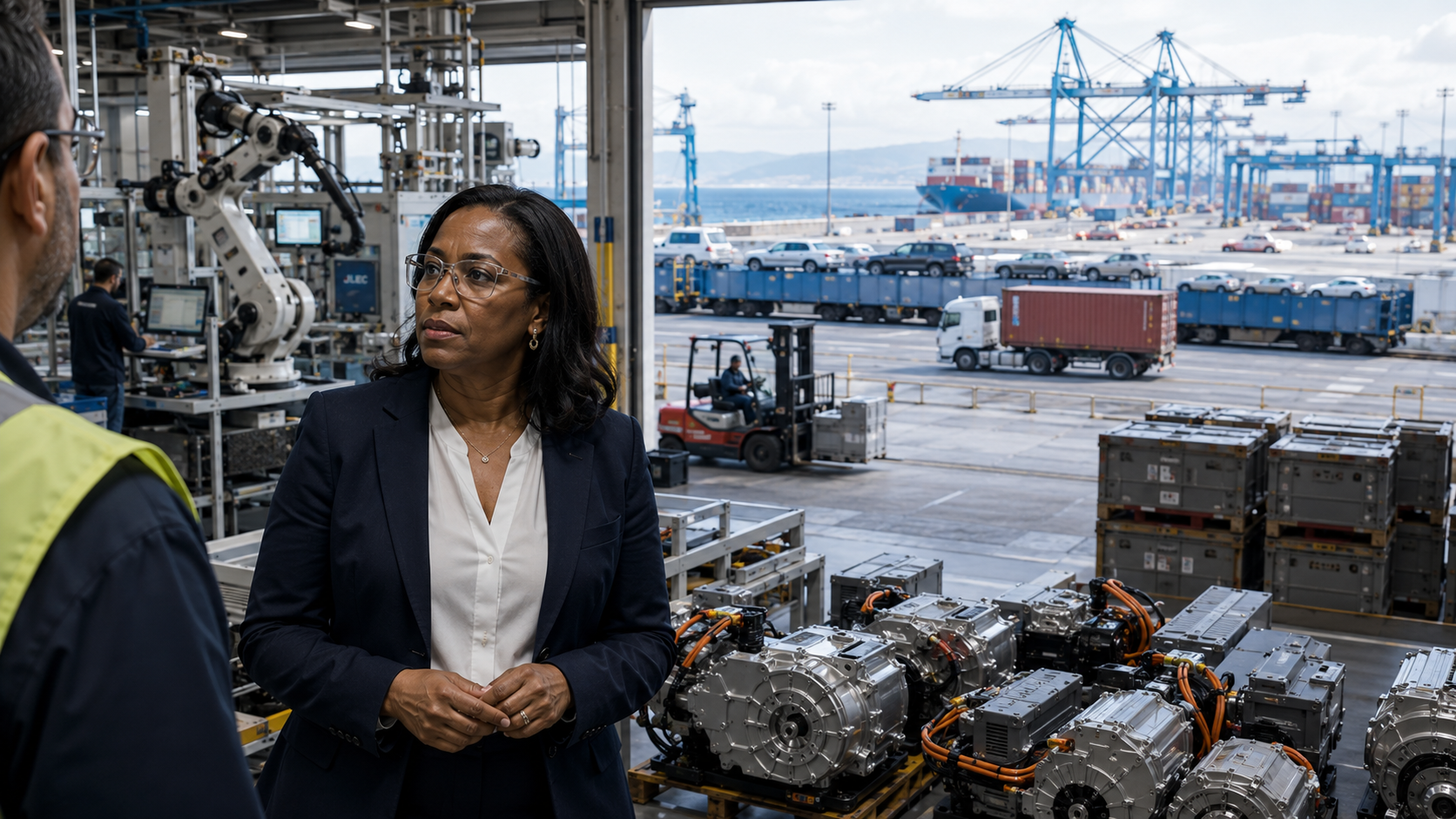
Morocco’s expanding automotive, electric-vehicle battery, aerospace, port, energy, tourism, and infrastructure industries are creating significant opportunities for U.S. businesses.
The opportunity, however, is not simply that Morocco is attracting factories and investment.
For a U.S. company, the more important question is whether its products, contracts, ownership structure, customs strategy, intellectual property, data practices, financing arrangements, and supply chain are structured to take lawful and commercially sustainable advantage of Morocco’s growth.
That question has become even more important in 2026.
Stellantis has begun production from its Smart Car platform at its expanded Kénitra operation. Morocco’s first major battery gigafactory is approaching production. Tanger Med handled more than 11 million containers during 2025. Nador West Med’s East Container Terminal completed operational-readiness testing in September 2026 and is preparing to receive its first commercial vessel calls. Safran is expanding Morocco’s role in aircraft-engine production and maintenance. At the same time, Morocco is accelerating transportation and tourism infrastructure investment in preparation for the 2030 FIFA World Cup.
Morocco therefore is not merely positioning itself as a lower-cost manufacturing location near Europe. It is developing an interconnected industrial platform involving ports, automotive manufacturing, battery production, aerospace, logistics zones, renewable energy, rail, airports, tourism infrastructure, digital services, and international supply chains.
For U.S. businesses, Morocco’s bilateral free trade agreement with the United States adds another potentially valuable element to that strategy.
But none of those advantages is automatic.
A business must determine not only whether Morocco presents an opportunity, but whether the particular transaction works legally, financially, operationally, and contractually.
Morocco’s Growth Is Industrial—but It Is Not Risk-Free
Morocco’s industrial expansion continues to be supported by automotive manufacturing, aerospace, infrastructure investment, tourism, logistics, and other sectors.
The International Monetary Fund has projected continued strong Moroccan growth in 2026, supported in part by substantial infrastructure investment. The IMF has also emphasized that large-scale public investment creates opportunities while requiring careful risk management.
The external-trade picture shows why businesses should look beyond headline growth figures.
During the first seven months of 2026, Moroccan goods imports increased 15.9% to approximately MAD 544.0 billion, while exports increased 8.4% to approximately MAD 299.3 billion. As a result, the goods trade deficit widened by 26.5%.
At the same time, investment and several export sectors have strengthened.
Net foreign direct investment flows into Morocco reached approximately MAD 29.47 billion through July 2026, an increase of 58.5% from the comparable 2025 period. That increase should be interpreted carefully: FDI receipts increased by approximately 6.3%, while investment-related expenditures declined substantially.
Automotive exports reached approximately MAD 107.14 billion through July 2026, an increase of 14.9% from the prior-year period. Aerospace exports also continued to grow.
The result is a more complicated picture than either “Morocco is booming” or “Morocco has a widening trade deficit.”
Morocco is undergoing substantial industrial and infrastructure investment while simultaneously importing large amounts of equipment, energy, materials, and other products necessary to support that expansion.
For an individual company, therefore, the relevant analysis is much narrower.
A supplier entering an established automotive ecosystem with a confirmed customer, appropriate certifications, an enforceable supply agreement, and a documented export route faces a different risk profile from a company investing solely because it has heard that Moroccan manufacturing is expanding.
The business must identify the particular industry, customer, regulator, facility, port, incentive, financing source, and revenue stream on which its investment depends.
Why Morocco Is Particularly Relevant to U.S. Companies
The United States–Morocco Free Trade Agreement entered into force on January 1, 2006.
In 2025, U.S.–Morocco goods trade totaled approximately $7.4 billion. U.S. goods exports to Morocco were approximately $5.5 billion, while U.S. goods imports from Morocco were approximately $1.9 billion. The United States also had substantial bilateral services trade with Morocco.
The agreement provides a framework covering areas including trade in goods and services, customs administration, investment, government procurement, intellectual property, labor, the environment, and transparency.
For a U.S. company, that framework may support several different strategies.
A manufacturer may export equipment or components to Morocco. A technology company may license software to a Moroccan automotive, aerospace, financial, healthcare, or logistics company. A U.S. supplier may participate in an industrial or infrastructure project. A company may establish a Moroccan operation to serve customers in Morocco or other regions.
But businesses should be careful with the phrase “free trade agreement.”
The existence of an FTA does not make every shipment duty-free.
It does not mean that every product assembled in Morocco becomes Moroccan in origin.
It does not eliminate value-added tax, product regulation, customs procedures, export controls, licensing requirements, or other trade measures.
The company must qualify for the particular benefit it expects to receive.
Duty-Free Treatment Depends on Rules of Origin
Preferential treatment generally depends on satisfying the applicable rule of origin.
Shipping a product from the United States does not by itself make that product U.S.-originating for FTA purposes.
Similarly, final assembly in Morocco does not necessarily make all of the resulting product Moroccan for every customs, tariff, tax-credit, procurement, or regulatory purpose.
Depending on the product, origin analysis may require reviewing where materials were produced, the finished product’s tariff classification, the tariff classification of important inputs, the manufacturing performed in each country, applicable tariff-shift requirements, value-content requirements, records, and direct-shipment or transit conditions.
For example, equipment manufactured in China, stored in the United States, relabeled, and then exported to Morocco does not automatically acquire U.S. origin merely because it was shipped by a U.S. company.
The reverse issue can arise when products manufactured or assembled in Morocco contain substantial Chinese, European, or other third-country inputs.
The business should conduct the origin analysis before deciding where production will occur, not after a factory or supply chain has already been established.
A product may be commercially described as “made in Morocco” while still failing to satisfy the specific origin rule required for the tariff or incentive treatment on which the transaction depends.
Chinese Investment Creates Opportunity—and Additional Compliance Questions
Chinese investment has become an important component of Morocco’s electric-vehicle and advanced-material strategy.
That investment can bring capital, manufacturing capabilities, battery technology, and access to global supply chains.
For U.S. companies, however, the nationality of the shareholder is only one part of the analysis.
Customs origin generally depends on applicable production and origin rules rather than corporate nationality alone. A Chinese-owned factory located in Morocco may produce Moroccan-origin goods when the applicable legal requirements are satisfied.
But ownership, technology, financing, and upstream sourcing can trigger separate concerns.
A U.S. business may need to determine whether inputs remain non-originating, whether parties are subject to trade restrictions, whether U.S. export controls apply to equipment or technology, whether upstream minerals or materials raise forced-labor concerns, and whether a U.S. or European customer imposes additional sourcing or ownership conditions.
The company may also need to determine whether subsidies, tax incentives, or government support could affect future trade-remedy analysis.
A Moroccan factory address does not erase the legal history of the technology, materials, ownership, financing, or supply chain behind the finished product.
That is particularly important for batteries, critical minerals, semiconductors, electronics, telecommunications equipment, and other strategically sensitive goods.
Morocco’s Automotive Industry Is Moving Into a New Production Phase
Automotive manufacturing remains one of the central components of Morocco’s industrial strategy.
Renault and Stellantis operate major manufacturing facilities, supported by a network of component manufacturers, logistics providers, industrial parks, and exporters.
One important development occurred on July 15, 2026, when Stellantis officially launched production from its Smart Car platform at its Kénitra facility. The initial vehicles include the Fiat Fastback and Grizzly.
Morocco’s automotive exports reached approximately MAD 107.14 billion during the first seven months of 2026, approximately 14.9% above the comparable period in 2025.
For U.S. companies, the opportunity extends well beyond manufacturing complete vehicles.
Automotive growth creates demand for automation, robotics, testing equipment, factory software, sensors, cybersecurity, battery-management technology, charging systems, tooling, industrial coatings, adhesives, packaging, logistics, engineering, quality-control systems, workforce training, and other specialized products and services.
But automotive contracts can impose significant downstream risk.
A supplier may face strict production schedules, certification standards, audit rights, traceability requirements, cybersecurity provisions, warranty obligations, environmental standards, recall procedures, and penalties associated with delivery failures.
The agreement should specifically address responsibility for rejected parts, field failures, production stoppages, expedited freight, tooling, design changes, customer-specific requirements, recalls, and warranty claims.
A smaller supplier should be particularly cautious about accepting unlimited or disproportionate liability for the production losses of a multinational manufacturer.
The value of a large automotive contract must be evaluated against the supplier’s insurance coverage, financial resources, production capacity, and ability to control the risks for which the contract makes it responsible.
Morocco’s Battery Industry Is Moving From Announcement Toward Production
Morocco’s battery strategy has reached an important stage.
Gotion Power Morocco is developing a lithium-iron-phosphate battery manufacturing complex in the Kénitra area. In September 2026, the president of Gotion’s Moroccan subsidiary stated that the first battery-cell production line is expected to begin production in October 2026, followed by a second cell line in November 2026, with assembled-battery sales expected before the end of the year.
That is a meaningful change from earlier descriptions that broadly anticipated a third-quarter 2026 production start.
Public descriptions of the project’s initial capacity also illustrate why companies should distinguish carefully between project announcements, financing tranches, and operating capacity.
The African Development Bank, which approved €100 million in financing in July 2026 and plans to mobilize additional financing partners, describes an initial project producing 10 GWh of battery cells and packs, with expansion toward 100 GWh. Gotion project environmental documentation describes Phase I as designed for 20 GWh of LFP battery capacity.
Those descriptions need not necessarily conflict; they may describe different financing or development scopes. But they demonstrate an important due-diligence principle:
A business should determine precisely which production line, capacity figure, financing stage, and operational date its contract depends upon.
The developing Moroccan battery ecosystem creates potential demand for production machinery, laboratory equipment, environmental controls, battery testing, industrial cybersecurity, software, fire suppression, recycling systems, logistics, engineering, quality assurance, and employee training.
It also creates complicated legal issues.
Battery transactions may involve customs origin, subsidies, critical-mineral sourcing, environmental reporting, export controls, supply-chain due diligence, customer sourcing policies, and European regulatory requirements.
A U.S. company supplying equipment, software, technical data, or technology should determine whether the item is controlled under applicable U.S. export laws and whether the ultimate owner, user, location, or application creates licensing concerns.
A company purchasing Moroccan batteries should separately determine whether those batteries satisfy the particular trade-agreement, procurement, tax-credit, incentive, or customer requirement on which its pricing depends.
Long-term agreements should address what occurs if a battery or battery component ceases to qualify for a particular tariff preference, tax benefit, subsidy, procurement program, or customer sourcing standard.
Aerospace Is Moving Into Higher-Value Production
Morocco’s aerospace industry continues to move beyond basic component production.
The country has developed an ecosystem involving aircraft wiring, structures, components, assemblies, maintenance, engineering, and other aerospace services.
Safran’s expansion illustrates the direction of that market.
The company is developing a new LEAP engine maintenance facility near Casablanca with capacity to service approximately 150 engines annually. Safran has also selected Morocco for a new LEAP-1A engine assembly line expected to become operational by the end of 2027, with capacity to assemble as many as 350 engines annually.
That creates potential opportunities for U.S. companies supplying components, inspection equipment, tooling, maintenance technology, training, logistics, software, engineering, and specialized services.
Aerospace transactions, however, require particularly disciplined compliance.
Technical assistance can itself create export-control issues.
An engineer who transmits controlled drawings, source code, software, manufacturing instructions, or other controlled technical information may create an export issue even when no physical item crosses the border.
Contracts should therefore address export-control responsibility, technical-data access, foreign-person access, cybersecurity, configuration control, inspection, counterfeit-part prevention, quality certification, recordkeeping, intellectual-property ownership, customer flow-down requirements, and ownership of jointly developed improvements.
Tanger Med Is More Than a Port
Tanger Med remains one of Morocco’s most significant commercial advantages.
In 2025, the Tanger Med Port Complex handled 11,106,164 TEUs, an increase of 8.4% from 2024.
Its automotive terminals handled 526,862 vehicles during 2025. That vehicle figure was actually down 12% from 2024, illustrating that even within a rapidly expanding industrial ecosystem individual traffic categories can move differently from year to year.
The port’s location near the Strait of Gibraltar connects manufacturers with European and international shipping routes, while its surrounding industrial ecosystem supports automotive, aerospace, electronics, logistics, textile, food, healthcare, and other businesses.
For a U.S. company, proximity to Tanger Med may improve access to suppliers, customers, and international transportation.
It can also create operational concentration risk.
A business locating near or depending heavily on one port should evaluate customs processes, warehousing, transport alternatives, utility reliability, labor availability, insurance, force majeure, industrial-zone terms, and what happens if port operations are interrupted.
A lease or industrial-zone agreement can be as important as the manufacturing agreement itself.
The company should understand rent adjustments, service charges, permitted uses, construction obligations, utility costs, subleasing, renewal rights, termination rights, restoration obligations, and ownership of improvements.
Nador West Med Is Entering Its Operational Phase
An important September 2026 development involves Nador West Med.
Earlier descriptions of the project referred generally to an anticipated opening during the second half of 2026.
That description should now be updated.
On September 10, 2026, West Med Container Terminal announced that the East Container Terminal at Nador West Med had completed its operational preparation and successful test call and was ready to receive and handle its first commercial vessel calls.
This does not mean businesses should treat every part of the wider Nador West Med industrial ecosystem as fully mature.
It means the project has moved from a future opening date into the initial operational-commercial phase.
Businesses considering projects connected to the port should still verify the particular terminal involved, its actual service schedule, rail and road connections, customs capability, utilities, available industrial property, awarded concessions, customer commitments, and the authority of the entity offering the contract.
This distinction between announced infrastructure and usable infrastructure is important.
A port can be technically operational before every surrounding industrial, logistics, utility, and commercial element reaches full maturity.
The 2030 World Cup Is Accelerating Broader Infrastructure Investment
Morocco’s preparations for the 2030 FIFA World Cup extend far beyond stadium construction.
The IMF estimates that accelerated connectivity and tourism infrastructure investment during 2024–2030 amounts to approximately MAD 190 billion and includes railway, road, airport, stadium, urban, and tourism-related infrastructure.
For U.S. businesses, the resulting opportunities may involve engineering, transportation systems, airport technology, cybersecurity, hospitality systems, healthcare infrastructure, accessibility, waste management, ticketing, consulting, construction technology, and other goods and services.
Major-event spending also creates legal and payment risk.
A business should determine whether its counterparty is a ministry, local government, state-owned enterprise, concessionaire, prime contractor, subcontractor, or private developer.
The identity of that party determines who is legally responsible for payment.
A government-backed project announcement does not automatically mean that every subcontractor or supplier has a sovereign payment guarantee.
Contracts for infrastructure-related projects should therefore address financing, milestones, inspections, acceptance, change orders, taxes, currency, delay, performance security, termination, dispute resolution, and payment security.
Government Procurement Benefits Have Limits
The U.S.–Morocco Free Trade Agreement contains government-procurement commitments, but a company should not assume that those commitments apply to every public entity or every Moroccan government-related transaction.
Coverage can depend on the procuring entity, contract value, subject matter, and other requirements.
Even where procurement commitments apply, the company must still comply with the tender.
Public procurements may require local registrations, French-language materials, technical certifications, bid bonds, performance guarantees, consortium arrangements, and strict filing deadlines.
A U.S. bidder should therefore analyze both the legal procurement framework and the actual contracting entity before pricing the transaction.
Long-term contracts should also allocate inflation, currency, tax, tariff, financing, delay, and change-order risk.
Investment Incentives Can Improve a Project—but Should Not Create the Project
Morocco’s Investment Charter provides several mechanisms intended to encourage domestic and foreign investment.
The principal investment-support mechanism can provide qualifying incentives reaching as much as 30% of eligible investment, depending on the project and applicable criteria.
Those incentives may materially improve project economics.
They should not be treated as guaranteed until the responsible authorities have approved the particular project and the required agreements are in place.
A company should determine which expenditures qualify, what form the support takes, what milestones apply, when the support becomes payable, whether employment or investment levels must be maintained, what reporting is required, and whether funds can be recovered if performance conditions are not satisfied.
It should also determine whether ownership changes require approval and whether the incentive creates any international subsidy, customs, procurement, or trade-remedy implications.
A project that works only if the maximum incentive is awarded is not yet a reliable investment model.
Market-Entry Structure Should Follow the Business Model
A U.S. company should choose its Moroccan market-entry structure based on what the company will actually do.
An exporter using a distributor has different legal needs from a manufacturer employing workers and leasing an industrial facility.
A subsidiary may be appropriate for a company maintaining inventory, employing personnel, holding licenses, providing local services, or manufacturing.
A joint venture may provide customer access, local knowledge, capital, or operational capability.
A branch may create a different combination of tax, liability, licensing, and permanent-establishment issues.
The business should consider ownership, control, tax, employment, licenses, foreign exchange, profit repatriation, government tenders, contracts, customer expectations, financing, and exit rights before selecting the structure.
Foreign investment is generally encouraged in Morocco, but businesses should confirm sector-specific restrictions and land rules for the particular project rather than relying on assumptions about economy-wide ownership rights.
Property due diligence should include title, permitted use, zoning, liens, environmental conditions, utilities, easements, taxes, construction approvals, financing rights, and transfer restrictions.
Industrial-zone occupancy may involve a lease, concession, development agreement, or incentive arrangement rather than conventional ownership.
The legal structure should match the company’s operating model and exit strategy.
Distributor Relationships Require More Than Trust
Local distributors can provide valuable market knowledge, customer access, regulatory support, product-registration assistance, customs experience, and commercial relationships.
They can also become a significant source of risk if the arrangement is informal or poorly documented.
A distributor agreement should address territory, products, sales channels, exclusivity, minimum purchases, forecasts, pricing, currency, payment, import responsibility, registration responsibilities, marketing, online sales, subdistributors, tenders, compliance, intellectual property, reporting, customer relationships, termination, and post-termination transition.
Exclusivity should normally be connected to measurable performance.
A distributor should not be able to retain broad exclusive rights indefinitely while failing to meet purchase targets, pay invoices, maintain required licenses, provide technical support, or protect the brand.
The foreign company should also determine who controls trademarks, domain names, social-media accounts, product registrations, customer lists, and marketing materials.
Those issues are much easier to negotiate before the relationship begins than after a successful market has been created.
Payment Terms Must Account for Morocco’s Foreign-Exchange Rules
Payment provisions should be designed around the actual banking and foreign-exchange framework.
Morocco’s General Instruction for Foreign Exchange Transactions 2026, or IGOC 2026, is the current regulatory framework governing a broad range of foreign-exchange transactions. The Office des Changes describes the 2026 framework as including measures affecting investment, exports, service imports, e-commerce, business travel, and hedging.
A U.S. seller therefore should not assume that any payment arrangement placed in a contract can necessarily be processed exactly as written.
The parties should confirm the current requirements with the Moroccan customer and its authorized bank for the specific transaction.
Depending on the circumstances, payment structures may involve deposits, milestone payments, documentary letters of credit, standby letters of credit, bank guarantees, documentary collections, credit insurance, or other security.
The agreement should identify the documents that trigger payment, responsibility for bank charges and confirmation costs, exchange-rate allocation, and responsibility for delays caused by missing or nonconforming shipping documents.
Signing a purchase order is not the same thing as receiving payment.
The seller must understand how the purchase price will lawfully and practically be transferred.
Intellectual Property Should Be Protected Before the Market Becomes Valuable
A U.S. trademark, patent, or other intellectual-property right should not be treated as a substitute for a Moroccan protection strategy.
Businesses entering the market should determine which trademarks, patents, industrial designs, copyrights, domain names, technical information, and other rights require protection.
Those decisions should generally be made before the company appoints a distributor, transfers manufacturing know-how, attends an important trade event, licenses technology, develops substantial local goodwill, or provides sensitive designs to a potential partner.
Contracts should also determine ownership of improvements, translations, packaging, websites, software, technical drawings, marketing content, tooling, test results, and locally developed materials.
A manufacturer should receive only the intellectual-property rights necessary to perform the authorized work.
The agreement should prohibit unauthorized overruns, unauthorized use of tooling, sale of rejected products, misuse of confidential information, and registration of the foreign company’s brand by the local partner.
Data Protection Applies to Local and Outsourced Processing
Morocco’s principal personal-data framework continues to be Law No. 09-08, administered by the National Commission for the Control of Personal Data Protection, or CNDP.
The CNDP states that organizations processing personal data may be subject to notification, authorization, security, confidentiality, and international-transfer requirements. It also confirms that processing carried out in Morocco for a foreign customer, including outsourced or offshored processing, can fall within Law 09-08.
That matters for U.S. companies using Moroccan call centers, developers, marketing providers, payroll companies, customer-support operations, health-data services, or other outsourced functions.
The company should determine which party is the controller, which party is the processor, what information is collected, whether sensitive information is involved, where the data are stored, what CNDP procedure applies, whether information will leave Morocco, and what security and breach-response obligations apply.
A standard U.S. services agreement may not adequately address Moroccan notification and international-transfer requirements.
Renewable Energy, Water, and Infrastructure Remain Important Opportunities
Morocco’s industrial development also creates demand for energy, water, and environmental infrastructure.
Manufacturing growth requires electricity, storage, grid infrastructure, industrial water, wastewater treatment, efficiency systems, and resilient utilities.
Water pressure continues to make desalination, wastewater reuse, irrigation efficiency, industrial water treatment, metering, pumps, membranes, and leak-detection technology commercially important.
For U.S. companies, these projects can create opportunities in technology, engineering, controls, software, cybersecurity, equipment, construction support, maintenance, and project development.
They can also involve public authorities, state-owned enterprises, concession arrangements, land rights, government guarantees, financing conditions, environmental permits, and long-term performance obligations.
The contract should identify the entity actually responsible for payment and should not characterize an obligation as government-guaranteed unless an enforceable guarantee exists.
Projects Connected to Western Sahara Require Separate Due Diligence
Projects located in or connected to Western Sahara require a distinct analysis.
The territory remains the subject of an active United Nations political process, and the United Nations Mission for the Referendum in Western Sahara, MINURSO, remains deployed in 2026. The mission’s mandate currently extends through October 31, 2026.
A company considering a project connected to the territory should separately evaluate territorial status, applicable customer and lender policies, origin claims, customs treatment, financing, insurance, sanctions screening, procurement requirements, stakeholder issues, environmental and social standards, and reputational exposure.
A policy position taken by one government does not necessarily resolve every legal or commercial question presented to a multinational business, bank, insurer, customer, or investor.
For that reason, transactions involving Western Sahara should not simply be treated as ordinary Moroccan projects without additional due diligence.
Contracts Should Be Designed for Enforcement
A commercially attractive transaction is not complete until the company knows how its rights can be enforced.
International and domestic arbitration may be available for commercial transactions, but the proper dispute mechanism depends on the parties, assets, governing law, financing structure, and type of transaction.
The agreement should address governing law, dispute forum, arbitration seat where applicable, language, interim relief, service of process, confidentiality, costs, evidence, and enforcement.
The company should also verify that the Moroccan counterparty has authority to enter the agreement.
Joint ventures, public contracts, concessions, industrial-zone arrangements, and state-owned-enterprise transactions may require corporate resolutions, government approvals, procurement compliance, or other authorization.
Where agreements are prepared in more than one language, the parties should identify which version controls in the event of inconsistency.
The objective should not simply be to produce a signed contract.
The objective should be to produce a contract that allocates foreseeable risk and can be enforced when the relationship no longer operates as expected.
How U.S. Businesses Should Prepare
A business considering Morocco should begin by defining the transaction precisely.
Exporting equipment to a Moroccan manufacturer is different from establishing a production facility. Licensing enterprise software is different from processing Moroccan consumer data. Selling equipment to a private industrial company is different from bidding on an airport, rail, or other publicly connected project.
The company should determine whether the U.S.–Morocco Free Trade Agreement applies to the transaction and whether the products satisfy the relevant origin requirements.
It should verify the local partner, contracting entity, industrial zone, financing source, customer, and project status.
It should determine which licenses, customs rules, data requirements, export controls, foreign-exchange requirements, tax considerations, intellectual-property protections, and procurement rules apply.
It should secure payment and negotiate contractual protections for currency movements, tariffs, regulatory changes, supply interruptions, delays, customer defaults, incentives, and termination.
Businesses relying on large infrastructure or industrial announcements should also distinguish among a project that has been announced, a project that has been financed, a facility that has completed construction, a facility that is operationally ready, and a facility that is actually producing at commercial scale.
Gotion and Nador West Med provide good 2026 examples of why those distinctions matter.
The company should also model the transaction under conservative assumptions.
If the project works only if the highest incentive is received, every product qualifies for preferential tariffs, the customer reaches projected volume immediately, and no regulatory change occurs, the company has not yet completed its risk analysis.
How TEIL Firms Can Help
Morocco’s industrial expansion creates multiple pathways for U.S. and international companies, but each pathway requires a different legal strategy.
A U.S. exporter may need to determine whether its products qualify for preferential treatment under the U.S.–Morocco Free Trade Agreement and whether the proposed payment arrangement complies with Moroccan foreign-exchange requirements.
An automotive or aerospace supplier may need manufacturing and supply agreements addressing quality, recall risk, production interruptions, tooling, intellectual property, cybersecurity, technical information, and export controls.
A battery or technology company may need to analyze origin, critical-material sourcing, technology transfer, regulatory changes, subsidies, data transfers, and customer sourcing restrictions.
An investor may need entity selection, incentive analysis, an industrial-zone agreement, property due diligence, a joint-venture structure, and an enforceable exit strategy.
A company participating in an infrastructure or government-related project may need procurement review, anti-corruption controls, payment security, performance-security analysis, and dispute-resolution provisions.
The Evans International Law Firms, LLC—TEIL Firms—helps U.S. and international companies structure Morocco and North Africa transactions before substantial capital, technology, products, intellectual property, or confidential information are placed at risk.
Our work may include U.S.–Morocco FTA and rules-of-origin analysis, international market-entry planning, distributor and agent agreements, joint ventures, automotive and aerospace supply agreements, battery and technology transactions, manufacturing agreements, industrial-zone and facility agreements, public-procurement risk review, intellectual-property strategy, data-transfer provisions, export controls, trade finance, tariff allocation, anti-corruption provisions, arbitration clauses, and exit planning.
A focused Morocco FTA, Manufacturing and Market Entry Risk Review can help a company determine whether its proposed products qualify for the expected tariff treatment, which entity should enter the transaction, whether the local partner has appropriate authority, which incentives are actually available, how intellectual property and data should be protected, how payment can be secured, and what happens if the project, customer, tariff treatment, incentive, supply chain, or regulatory environment changes.
The objective is not merely to prepare a contract.
It is to make certain that the manufacturing, export, licensing, investment, or distribution strategy works legally and commercially before the company transfers technology, grants exclusivity, places equipment, relies on an incentive, or commits substantial capital.
Conclusion
Morocco’s emergence as an automotive, electric-vehicle battery, aerospace, logistics, energy, and infrastructure platform remains one of the most significant African business developments for U.S. companies in 2026.
The developments of the past year make that opportunity more concrete.
Stellantis is producing vehicles from a new platform at Kénitra. Automotive exports have continued to rise. Gotion is preparing to begin battery-cell production. Safran is expanding Morocco’s role in aircraft-engine assembly and maintenance. Tanger Med has exceeded 11 million annual container units. Nador West Med has reached operational readiness for its first commercial container calls. Infrastructure investment continues to accelerate ahead of the 2030 World Cup.
Those developments do not eliminate legal risk.
A shipment from the United States may not satisfy the applicable FTA origin rule.
A product assembled in Morocco may retain important third-country content.
A factory announcement may precede commercial production by months or years.
An investment incentive may depend on milestones that are not ultimately satisfied.
A distributor may obtain control over customer relationships or local brand assets.
A public project may not carry a sovereign payment guarantee.
Technology supplied to a Moroccan operation may remain subject to U.S. export controls.
Personal-data processing may require Moroccan notifications, approvals, or transfer procedures.
A business may become dependent on one customer, one industrial cluster, one port, or one tariff assumption.
The companies positioned to benefit most from Morocco’s development will therefore be those that use the country’s advantages without assuming that a free trade agreement, industrial zone, government announcement, or large multinational investment eliminates the need for due diligence.
Morocco offers U.S. businesses a growing opportunity to participate in an increasingly sophisticated African industrial economy while connecting with customers and supply chains across multiple regions.
Capturing that opportunity requires a legal and commercial structure as sophisticated as the supply chain it is designed to support.
This article is provided for general informational purposes only and does not constitute legal, tax, customs, investment, financial, or other professional advice. FTA eligibility, rules of origin, tariffs, investment incentives, foreign-exchange requirements, data obligations, land rights, export controls, sanctions requirements, procurement rights, and contractual remedies depend on the specific product, project, parties, location, transaction structure, and law in effect at the relevant time.