
From O’Hare to Overseas: How Supply Chain Security Is Becoming a Legal Issue
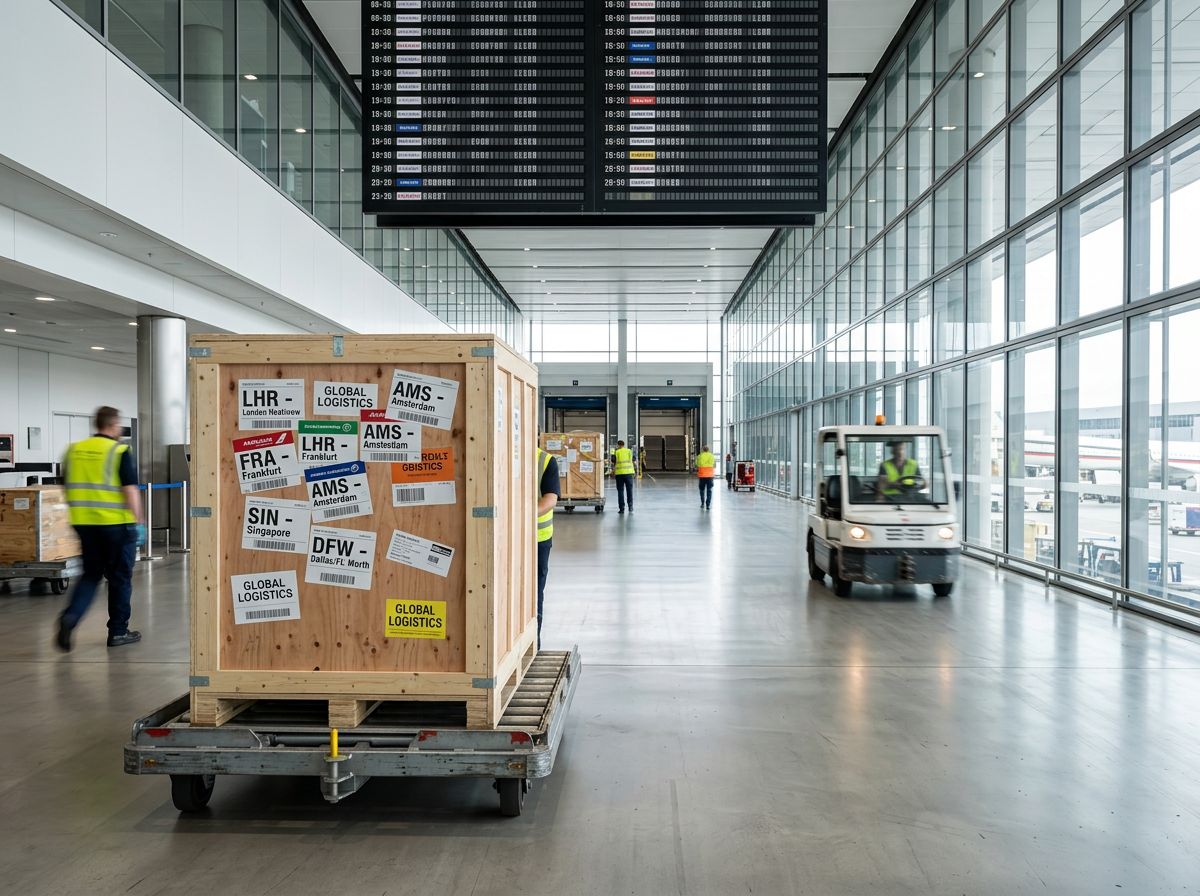
For many companies, the movement of goods has always been treated as a logistics function.
Products are manufactured, packaged, and shipped. Freight forwarders coordinate transportation. Carriers move cargo across borders. Customs brokers handle clearance. As long as shipments arrive on time and in good condition, the system appears to be working.
That view is becoming outdated.
The physical movement of goods is no longer just an operational process.
It is a legal one.
As global supply chains become more scrutinized, the path a product takes—from origin to destination—is now tied to a growing set of legal obligations that extend well beyond delivery. What happens between the point of departure and the point of arrival is no longer invisible. It is subject to review, verification, and, increasingly, enforcement.
For companies operating through major trade hubs like O'Hare International Airport, this shift is particularly significant.
O’Hare is one of the primary gateways for international cargo entering and leaving the United States. That volume creates efficiency, but it also places shipments within a system where security, compliance, and documentation are closely integrated. The movement of goods through such a hub is not simply a matter of transportation.
It is a regulated event.
Cargo security sits at the center of this change.
Historically, security measures were designed to protect the physical integrity of shipments and the safety of transportation systems. Today, those measures are increasingly connected to broader compliance requirements. Authorities are not only concerned with what is being shipped, but also with where it came from, how it was handled, and whether it aligns with regulatory expectations tied to trade, sanctions, and ESG considerations.
This is where the concept of chain of custody becomes critical.
A shipment does not move in a straight line.
It passes through multiple hands—suppliers, subcontractors, consolidators, carriers, and intermediaries—before reaching its final destination. Each point in that chain represents a potential break in visibility. When that visibility is incomplete, the company’s ability to explain and support the movement of its goods is reduced.
That reduction in clarity creates risk.
A breakdown in chain of custody may not be apparent during routine operations. It becomes visible when a shipment is reviewed more closely—during a customs inspection, a regulatory inquiry, or a compliance audit. At that point, the company is asked to demonstrate not only what was shipped, but how it moved and whether each step in the process can be accounted for.
If that information is not available, the issue is no longer logistical.
It becomes legal.
Customs holds are often the first indication that something is misaligned.
A shipment may be delayed because documentation does not fully support the origin, classification, or handling of the goods. Questions may arise about the consistency of information provided across different stages of the transaction. Even when the underlying activity is legitimate, the inability to clearly demonstrate it can lead to delays that disrupt operations and strain relationships.
These delays are not simply inconveniences.
They carry financial and reputational consequences.
Customers expect reliability. When shipments are held, delivery timelines are affected. When timelines are affected, confidence is impacted. Over time, repeated disruptions can change how the business is perceived, regardless of its underlying performance.
The legal dimension becomes more complex as ESG considerations intersect with supply chain security.
Regulatory and market attention on forced labor, environmental practices, and sourcing transparency has introduced new layers of scrutiny into how goods move across borders. Companies are no longer evaluated solely on the basis of the final product. They are evaluated on the conditions under which that product was produced and the integrity of the chain through which it traveled.
This means that security and compliance are no longer separate functions.
They are converging.
A shipment that cannot be traced clearly through its supply chain may raise questions not only about its physical handling, but also about the practices associated with its production. Documentation that was once sufficient for customs purposes may now be examined in the context of broader ESG expectations. The same data used to move goods efficiently is now used to assess whether those goods meet evolving legal and ethical standards.
This convergence changes how companies need to think about logistics.
The movement of goods is no longer a self-contained process.
It is part of a larger system that includes contractual obligations, regulatory requirements, and reputational considerations. Each shipment carries with it a set of assumptions about where the goods came from, how they were handled, and whether those facts can be demonstrated if questioned.
When those assumptions are not supported by clear processes, the company is exposed.
This exposure is not limited to enforcement.
It also affects transactions.
During financing or acquisition processes, supply chain security is increasingly part of diligence. Buyers and lenders look beyond operational efficiency to understand whether the company has visibility and control over how its goods move. Gaps in chain-of-custody documentation, inconsistencies in handling procedures, or uncertainty around supplier practices can raise concerns that influence valuation and deal structure.
In this context, logistics becomes a proxy for control.
The companies that manage this effectively do not simply move goods.
They understand the legal framework that surrounds that movement.
They ensure that documentation aligns with reality at each stage of the process. They maintain visibility into how goods are handled, even when third parties are involved. They integrate security considerations with compliance and ESG requirements, recognizing that these elements are increasingly evaluated together.
This creates a system that can withstand scrutiny.
For leadership teams, the key question is not whether shipments are moving.
It is whether the company can demonstrate how they move.
A focused review can identify where chain-of-custody processes may be incomplete, where documentation practices may introduce risk, and where security and compliance functions are not fully aligned. In many cases, the most significant gaps are not visible until the movement of goods is examined as part of a broader legal framework.
That is where TEIL is working with companies now.
Supply chain security does not need to be treated as a separate function.
It can be integrated into the legal structure that supports cross-border operations.
If your organization depends on the reliable movement of goods, now is the time to ensure that your logistics processes reflect the level of scrutiny already being applied. Schedule a supply chain security and compliance review with TEIL to assess where your current approach may create exposure—and where alignment can strengthen your operations as you move from O’Hare to overseas markets.