
Country of Origin Is Not the Same as Country of Shipment
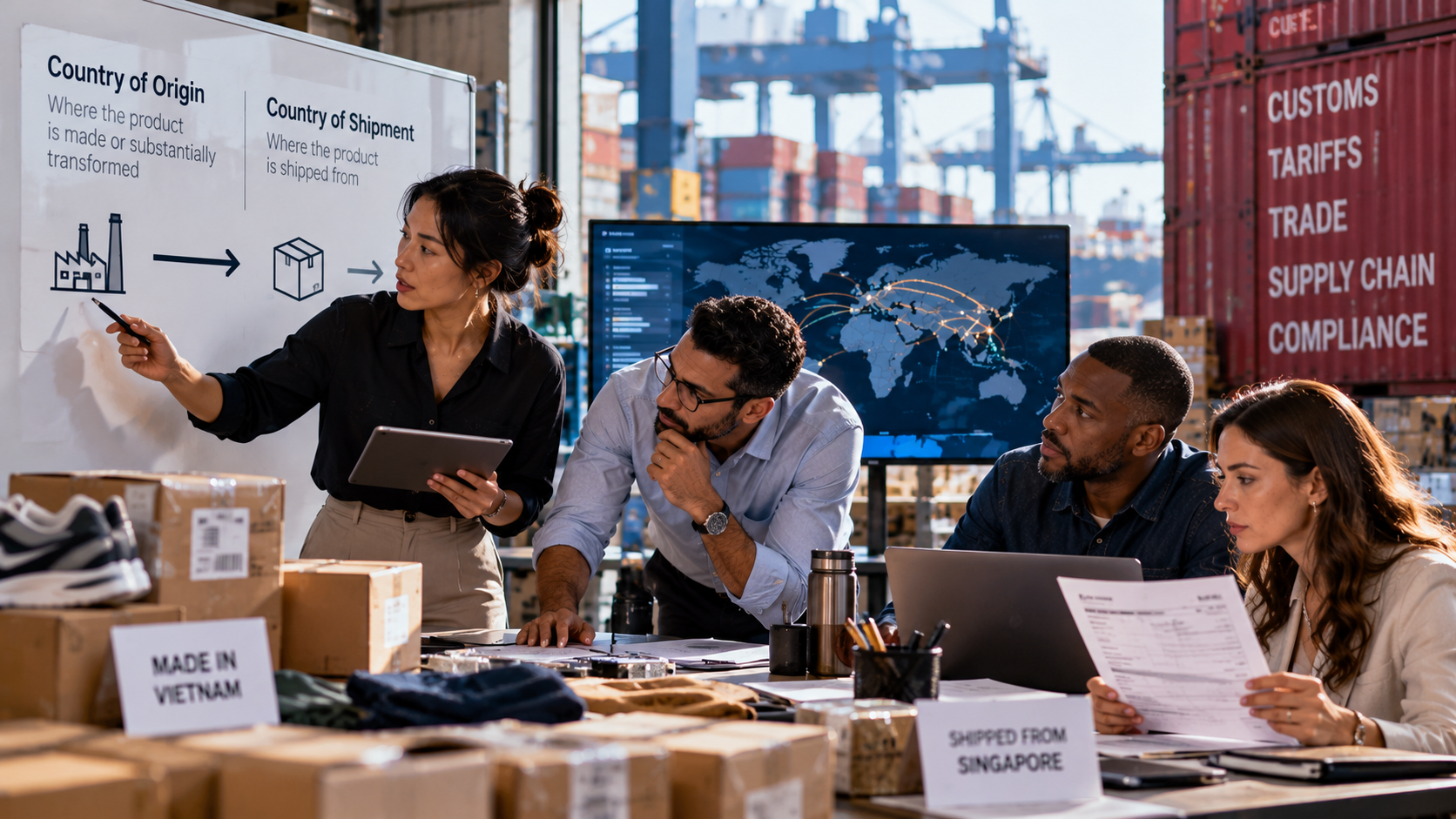
International supply chains rarely move in a straight line. A product may be manufactured in China, shipped to Vietnam for assembly or packaging, routed through Singapore for consolidation, and then exported to the United States. The commercial paperwork may show Vietnam or Singapore as the country of export, but that does not necessarily make either country the legal country of origin for U.S. customs purposes.
That distinction has become increasingly important as tariffs, trade remedies, and supply-chain diversification push companies to reconsider where products are manufactured and how they enter the United States. A business may legitimately move part of its production from China to another country, but simply moving goods through that country does not automatically change their origin. U.S. Customs and Border Protection looks at where the product was actually manufactured or produced and, when production occurs in more than one country, whether the later processing was significant enough to create a new article. For many non-preferential origin determinations, that analysis centers on the concept of substantial transformation. Trade.gov
For Midwest importers, manufacturers, retailers, and distributors buying through global supply chains, this is more than a labeling issue. Country of origin can affect Section 301 tariffs, antidumping and countervailing duties, marking requirements, admissibility, preferential tariff treatment, and the accuracy of customs declarations. A company that relies only on the country listed on a supplier's commercial invoice may therefore be overlooking one of the most important facts in the transaction.
Country of Export and Country of Origin Answer Different Questions
The country of shipment usually tells you where the goods were exported from immediately before entering the United States. Country of origin asks a different question: Where is the product legally considered to have been made?
Those answers can be the same, but they do not have to be.
CBP's Section 301 guidance makes the distinction particularly clear. Additional Section 301 duties apply based on the country of origin, not merely the country from which the merchandise was exported. That means Chinese-origin merchandise does not stop being Chinese-origin merchandise simply because it was shipped to the United States from Hong Kong, Vietnam, Malaysia, Mexico, or another intermediary country. U.S. Customs and Border Protection
Imagine a U.S. company purchasing electronic components originally manufactured in China. The Chinese supplier ships those components to Vietnam, where they are inspected, repackaged, and placed into retail cartons. The cartons are then exported from Vietnam to the United States.
Vietnam is unquestionably the country of shipment. But if the work performed there does not substantially transform the Chinese components, China may remain the country of origin for U.S. customs purposes.
The difference can have significant financial consequences. If the merchandise is subject to additional duties because it is a product of China, routing it through another country does not erase those duties. The customs declaration must reflect the legally correct origin rather than simply the final shipping point.
Substantial Transformation Is the Core Question in Many Multi-Country Supply Chains
When an article is produced entirely in one country, determining origin may be relatively straightforward. The analysis becomes more complicated when materials or components from one country undergo additional processing in another.
For many non-preferential U.S. origin determinations, the traditional test asks whether the later manufacturing results in a substantial transformation. CBP generally considers whether the processing creates a new and different article with a different name, character, or use from the components or materials that entered the process. CBP Rulings
The Department of Commerce describes substantial transformation as a fundamental change in the product's form, appearance, nature, or character that normally results from manufacturing or processing in the country claiming origin. Depending on the applicable rule, the analysis may consider manufacturing operations, changes in tariff classification, value added, or other product-specific criteria. Trade.gov
The important point is that there is no universal rule saying that performing any work in a second country changes origin.
Minor finishing may not be enough. Repackaging may not be enough. Simple assembly may not be enough. Adding labels or conducting quality-control inspections may not be enough. Whether a substantial transformation occurred depends on what actually happened to the product.
CBP rulings repeatedly illustrate this point. In one recent ruling involving wheel-hub bearings, CBP analyzed Chinese components that underwent additional processing and assembly in Vietnam. The agency concluded that simply pressing components together was not itself the type of processing that would substantially transform the Chinese parts. Instead, CBP examined where the components that imparted the essential character of the finished bearing were actually formed and processed. CBP Rulings
That kind of analysis is why businesses should be cautious about accepting statements such as “assembled in Vietnam” or “finished in Mexico” as automatic proof that the product originates there.
Repackaging Chinese Goods in Another Country Usually Does Not Create a New Origin
One of the clearest examples involves repackaging.
Suppose a Chinese manufacturer produces finished kitchen appliances. The appliances are shipped to Malaysia, where workers remove the original packaging, add English-language instructions, place the products into new branded boxes, and then export them to the United States.
The Malaysian operation may have commercial value, but it does not necessarily transform the appliances into Malaysian products. The goods entering Malaysia and the goods leaving Malaysia are still fundamentally the same kitchen appliances.
CBP has reached similar conclusions in cases involving packaged merchandise. In a recent ruling concerning tool sets, CBP determined that simply packaging tools together in a fitted retail box did not substantially transform the individual components. Each component retained its own country of origin for marking purposes. CBP Rulings
The same logic can apply to other limited activities such as relabeling, sorting, inspecting, cleaning, or minor finishing. The question is whether the second country's operations actually create something new, not whether the product spent time there before being exported.
For companies redesigning their supply chains to reduce exposure to China-related tariffs, that distinction is critical. Moving the final packaging operation out of China may have legitimate logistical or commercial benefits, but it should not automatically be treated as an origin change.
Assembly Can Change Origin, but Not Every Assembly Operation Does
Assembly is more complicated because some assembly operations are substantial enough to create a new product while others are not.
CBP generally examines the nature and extent of the manufacturing process. Relevant considerations can include the number and importance of components, the complexity of the assembly, the amount of skill and time involved, the number of manufacturing steps, whether the individual components lose their separate identities, and whether they become integral parts of a new article. CBP Rulings
A simple operation in which two mostly finished components are screwed, pressed, or clipped together may not substantially transform them. A complex manufacturing process that converts numerous parts into a functionally different finished product may produce a different result.
That is why statements such as “final assembly occurs in Mexico” or “the product is completed in Vietnam” are not enough by themselves. The company needs to understand what final assembly actually means.
If the foreign facility receives finished Chinese motors, finished Chinese control boards, finished Chinese housings, and finished Chinese wiring assemblies and merely puts them together, CBP may examine whether the Chinese components retained their identity and whether the assembly was sufficiently meaningful to create a new article.
If, by contrast, the second-country facility performs substantial manufacturing that changes the components' character and produces a commercially distinct product, the origin analysis may be different.
The facts matter.
Chinese Components Do Not Automatically Make the Finished Product Chinese Either
The reverse assumption can also be wrong.
A company should not conclude that a product must remain Chinese simply because some components originate in China. If those components undergo substantial manufacturing in another country, the finished article may acquire the origin of the country where that transformation occurred.
For example, a manufacturer in Mexico may import raw materials or components from China and subject them to extensive machining, fabrication, programming, chemical treatment, molding, or other production processes that create a new finished product. Depending on the applicable origin rule and the facts, Mexico may become the relevant country of origin.
This is an important distinction for companies considering nearshoring.
A business does not necessarily need a completely China-free supply chain before a Mexican manufacturing operation can create Mexican-origin goods. But simply moving Chinese components to Mexico and performing minimal assembly does not guarantee the same result.
The correct question is therefore not, “Were any Chinese components used?” It is “What happened to those components after they arrived in the second country?”
That requires understanding the actual manufacturing process rather than looking only at supplier invoices.
Free Trade Agreements Can Use Different Origin Rules
Substantial transformation is important, but businesses should also understand that it is not the only origin test used in international trade.
Free trade agreements often contain their own product-specific rules of origin. Those rules may require a particular change in tariff classification, a specified percentage of regional value content, certain manufacturing operations, or some combination of those standards. The Department of Commerce specifically notes that preferential origin rules can apply substantial-transformation concepts in different ways depending on the agreement and product. Trade.gov
That means the question “What is the country of origin?” sometimes needs another question attached to it: “For what legal purpose?”
The analysis used to determine ordinary marking origin may not always be identical to the analysis required to determine eligibility for preferential tariff treatment under a trade agreement. Likewise, special rules exist for certain product categories and trade-remedy programs.
For a manufacturer using China-origin inputs in Mexico and importing the finished product into the United States, for example, one analysis may concern ordinary country-of-origin treatment while another asks whether the product satisfies the specific rules necessary to qualify for preferential treatment under USMCA.
Those should not be treated as interchangeable conclusions.
Businesses claiming preferential tariff treatment should therefore review the actual agreement's origin requirements rather than assuming that performing substantial work in a participating country automatically qualifies the product.
Section 301 Tariffs Make Origin Particularly Important for Chinese Goods
Country-of-origin analysis has taken on greater importance because of the additional Section 301 duties imposed on many products of China.
CBP expressly states that Section 301 duties are based on origin rather than country of export. U.S. Customs and Border Protection
That means a Chinese-origin product subject to Section 301 duties does not avoid those duties merely because it travels through another country before entering the United States.
This is one reason businesses restructuring China-based supply chains need to evaluate the manufacturing process carefully. There is an important legal difference between moving meaningful production into another country and simply routing Chinese merchandise through that country.
Recent enforcement actions show that the government is actively pursuing alleged misstatements involving this distinction. In 2026, the Justice Department announced a $54.4 million settlement involving allegations that Chinese-manufactured tungsten carbide products were transshipped through Taiwan and declared as Taiwanese-origin merchandise to avoid Section 301 duties. The government's allegations also included incorrect tariff classification and country-of-origin marking issues. Department of Justice
In another 2026 settlement, a Taiwan-based LED manufacturer agreed to pay $5.15 million to resolve allegations involving Chinese-manufactured LEDs that were transshipped through Taiwan and declared as Taiwanese origin. Department of Justice
Those cases do not mean that manufacturing in Taiwan, Vietnam, Mexico, or another country can never change the origin of Chinese components. They illustrate the difference between legitimate manufacturing that satisfies the applicable origin rules and merely moving products through another jurisdiction while declaring the routing country as the origin.
Transshipment Is Not the Same as Legitimate Supply-Chain Diversification
Businesses should distinguish legitimate multi-country manufacturing from transshipment intended to conceal origin.
There is nothing inherently improper about shipping Chinese components to Vietnam, Mexico, Malaysia, or another country for manufacturing. Modern supply chains routinely use inputs from multiple jurisdictions. The issue is whether the declared country of origin accurately reflects the applicable legal rules and the manufacturing that actually occurred.
A company may legitimately move production from China to Vietnam and, after a sufficient manufacturing process, produce Vietnamese-origin goods. Another company may ship finished Chinese merchandise to Vietnam, change the packaging, and send it to the United States. Those two supply chains may look superficially similar on a shipping map but produce very different customs results.
The Justice Department has pursued cases involving goods that were allegedly shipped through intermediary countries specifically to conceal Chinese origin. For example, the government previously alleged that aluminum extrusions manufactured in China were merely routed through Malaysia while being declared as Malaysian goods. Department of Justice
More recently, federal prosecutors announced a $7.3 million settlement involving allegations that Chinese-manufactured plastic retail carrier bags were transshipped through Hong Kong while the country of origin was misrepresented to avoid antidumping duties. Department of Justice
The commercial lesson is straightforward: changing the route does not necessarily change the origin.
The Importer Cannot Rely Blindly on What the Supplier Writes on the Invoice
U.S. importers should pay particular attention to origin because customs compliance responsibility does not disappear simply because a foreign supplier prepared the paperwork.
Under U.S. customs law, importers of record are expected to use reasonable care in providing the information necessary for CBP to assess duties and determine whether applicable legal requirements have been satisfied. U.S. Customs and Border Protection
A customs broker can assist with an entry, but using a broker does not necessarily transfer ultimate responsibility for the accuracy of the import information away from the importer. CBP itself notes that while brokers may assist with the process, compliance responsibility remains with the party responsible for the entry. CBP Help Center
That creates a practical problem when suppliers use origin casually.
A purchase invoice may say “Made in Vietnam” because the product was shipped from Vietnam. A salesperson may say “Mexican origin” because the company performs final assembly there. A supplier certificate may contain an origin statement copied from previous paperwork.
None of those documents necessarily resolves the legal question.
An importer dealing with goods that have meaningful inputs from China or another country subject to additional duties should understand the manufacturing process well enough to evaluate whether the claimed origin makes sense. Depending on the risk, that may involve obtaining bills of materials, manufacturing flowcharts, component-origin information, factory records, supplier certifications, photographs, production records, or other documentation.
The amount of diligence should reflect the transaction. A low-risk commodity made entirely in one country does not necessarily require the same investigation as a complex product assembled from Chinese components in a third country while the importer is claiming tariff treatment based on the second country.
A Supplier Certificate Helps, but It Is Not a Substitute for Understanding the Supply Chain
Supplier certifications can be useful because they create a written record of what the supplier represents about the merchandise. They can also provide contractual remedies if the information proves false.
But a certificate should not become a substitute for common sense.
If a supplier states that a highly complex product is "Made in Vietnam," but the factory appears to have only a small packaging operation, the importer may need more information. If production allegedly shifted out of China immediately after a tariff increase while the product, pricing, lead time, packaging, and supplier relationships remained unchanged, that may justify asking what manufacturing actually moved.
The same is true when a distributor refuses to identify the manufacturer, cannot explain the production process, or provides inconsistent origin documentation.
Importers do not need to assume that every foreign supplier is concealing something. They should, however, have a process for investigating information that does not fit the transaction.
Origin provisions can also be built into supplier agreements. A contract can require the supplier to accurately identify component and finished-product origin, notify the buyer before changing manufacturing locations, maintain supporting records, cooperate with customs inquiries, and indemnify the buyer for losses resulting from inaccurate origin information where appropriate.
Those protections are especially valuable when tariffs or trade remedies make origin economically significant.
Country-of-Origin Marking Is Related but Should Not Be Confused With the Entire Analysis
Most foreign-origin merchandise entering the United States is subject to country-of-origin marking requirements under 19 U.S.C. § 1304 and Part 134 of the CBP regulations, subject to various exceptions. CBP generally defines origin for those purposes as the country of manufacture, production, or growth, with additional work in another country needing to result in substantial transformation before that second country becomes the origin. CBP Rulings
This is why simply replacing a “Made in China” label with a “Made in Vietnam” label does not itself change origin.
The label must reflect the legal origin; the label does not create it.
Businesses should also avoid assuming that phrases such as “Assembled in,” “Designed in,” or “Packaged in” necessarily satisfy country-of-origin marking requirements. CBP has rejected markings that could mislead buyers about where a product was actually made. In one watch ruling, for example, CBP concluded that language emphasizing French components and Philippine assembly was insufficient because it did not clearly identify the Philippines as the country of origin. CBP Rulings
Marketing language and customs-origin language therefore need to be coordinated carefully, particularly when several countries contribute to the product.
When the Answer Is Unclear, a CBP Ruling Can Be Valuable
Some origin determinations are straightforward. Others are genuinely difficult.
A product may involve components from several countries, multiple manufacturing stages, specialized engineering, software installation, fabrication, and final assembly. In those situations, trying to reduce the analysis to a percentage such as “60% was done in Mexico, so it must be Mexican” can be misleading unless the applicable rule actually uses that calculation.
CBP maintains a ruling process through which businesses can request a determination concerning prospective transactions. CBP's searchable CROSS database also contains prior rulings that can provide insight into how the agency has analyzed similar manufacturing processes and products. CBP itself directs businesses dealing with Section 301 origin questions to its ruling resources where appropriate. U.S. Customs and Border Protection
Prior rulings can be helpful, but small factual differences may change the result. Two products may both be described as “assembled in Vietnam” while involving dramatically different manufacturing processes.
For transactions involving substantial tariff exposure or a long-term supply-chain restructuring, obtaining a clear origin analysis before large volumes begin moving can be considerably less expensive than trying to resolve the issue after CBP questions years of entries.
What Importers Should Review Before Accepting a New Country of Origin
Businesses sourcing products through multiple countries should begin by mapping where each meaningful manufacturing step actually occurs. The analysis should identify where the principal components originate, what processing takes place in each country, which facility performs the work, and what condition the product is in when it enters and leaves each stage of production.
If the company has recently moved work from China to Vietnam, Mexico, India, Malaysia, or another manufacturing location, it should determine whether the change represents genuine production or primarily a change in shipping route, packaging, or final assembly.
Importers should also confirm which origin rule applies to the particular purpose. The analysis for ordinary non-preferential origin, Section 301 duties, preferential treatment under a free trade agreement, marking, and certain product-specific regimes may not always be identical.
Supplier contracts and compliance procedures should reflect those distinctions. Companies may want suppliers to disclose changes in factories, component sourcing, or manufacturing processes because a seemingly ordinary sourcing change can affect the origin conclusion that supports the customs entry.
Finally, origin documentation should be maintained before a question arises. Reconstructing a manufacturing process years later can be difficult, particularly when factories close, suppliers change, employees leave, or production records are no longer available.
The Bottom Line
Country of origin follows the manufacturing and the applicable legal rules, not simply the shipping route.
A Chinese product does not become Vietnamese because it was placed in a Vietnamese box. It does not become Malaysian because it was warehoused in Malaysia. It does not become Mexican because a Mexican distributor exported it to the United States. To change origin, the processing performed in another country must satisfy the applicable origin rule, which in many non-preferential cases requires a genuine substantial transformation into a new and different article.
At the same time, the presence of Chinese components does not automatically mean the finished product must remain Chinese. Meaningful manufacturing in another country can change the result. The critical question is what was actually done to the merchandise and which origin rule governs that transaction.
For importers facing China-related tariffs, sourcing shifts, nearshoring decisions, or multi-country manufacturing arrangements, that distinction should be resolved before the first customs entry is filed. Once merchandise has been imported repeatedly under an incorrect origin, the issue is no longer merely about how the next shipment should be labeled. It can become a question of unpaid duties, prior entries, penalties, supply-chain disruption, and government enforcement.
This article is provided for informational purposes only and does not constitute legal advice.
Importing products that are manufactured, assembled, or routed through more than one country? TEIL Firms can help you evaluate country of origin, substantial transformation, China-related tariff exposure, supplier documentation, customs compliance, and the contractual protections surrounding your international supply chain. Click the button below to get legal support before an incorrect origin determination turns into unexpected duties, shipment delays, or a customs enforcement problem.